

Last substantive check: September 26, 2026
In brief
The value of a Magic card depends on the exact printing, the condition, and supply and demand. A mythic is not automatically expensive, and a foil is not automatically worth more than the regular version.
First, look up your specific printing, then compare relevant prices, and distinguish between asking price, selling price, and what you actually keep.
An old box in the attic, a nice card from a booster pack, or a binder you want to sell: where do you start with valuation? Googling only the card name can lead you down the wrong path. The first price you see might belong to a different printing, a foil version, or a professionally graded copy.
Below, you will walk through the process step by step. You will learn what data you need, how to compare prices, and when further research or grading might be useful.
Quick links
Valuing your MTG card in five steps
1. Find the right card and printing
Use Scryfall to view the different versions. Don't just compare the artwork; check the set symbol, the card number, and the small text at the bottom.
- Name: verify that you are actually looking at the same card.
- Set and collector number: these together help identify the specific printing.
- Language: compare your language with the same language when checking prices.
- Version: for example, regular, borderless, showcase, or promo.
- Finish: nonfoil, traditional foil, etched foil, or another special finish.
Older cards do not always have a set code or card number. In those cases, look at the border, the set symbol, the copyright line, and the back. A scanner can help with searching, but always verify the chosen edition yourself.
2. Assess the condition
A price for a Near Mint copy is not a good comparison for a card with a crease or visible wear. Check the front and back, corners, edges, and surface under good light. For foils, angled light helps to spot scratches.
Further down, you will find the condition guidelines from Cardmarket. Note any damage before selecting a price.
3. Compare relevant listings
For comparisons within the European market, you can use Cardmarket. Search for the correct product and compare copies with the same language, finish, and similar condition.
Look at multiple listings. One strikingly low price might be for a damaged card; one high asking price does not prove that someone is actually paying that amount. When making a purchase, factor in shipping costs as well. A cheap card from an individual order might be less attractive once those costs are added.
4. Put price information into context
An asking price is what a seller wants to receive. A realized sale price shows what a copy actually sold for. If you can find such sales data, check the printing, condition, and sale date there as well.
Use a price trend or average as an extra indicator. Do not assume that a general price figure corresponds exactly to your language and condition. If there are few comparable copies, an estimate remains even more uncertain.
Scryfall is mainly useful for identification and an initial price indication. According to Scryfall, the price data is periodically retrieved from partners; the amount is not a guaranteed current offer for your card.
5. Note a price range and a date
Write down, for example: card name, set, card number, language, finish, condition, comparable prices, and date. It is better to choose a well-founded range than a supposedly exact amount down to the cent.
Tip from SpellArmory
When selling a card, take clear photos of the front and back and close-ups of any damage. Do not use filters. This allows a buyer to better assess whether your copy matches the description.
The same card name does not mean the same price
Rhystic Study clearly shows why you need to look beyond the name. The card appeared in Prophecy as a common. The version shown below from Wilds of Eldraine: Enchanting Tales is a mythic rare and features different artwork and a different frame.
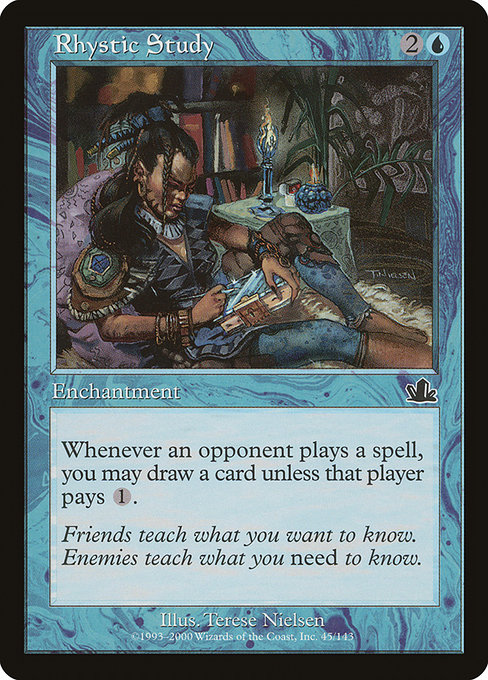
Prophecy — number 45
Common, original card version.
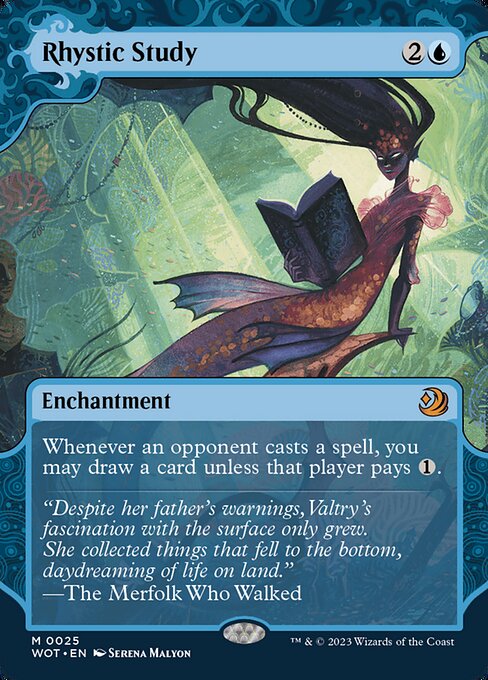
Enchanting Tales — number 25
Mythic rare, different artwork and frame.
It remains the same card in terms of gameplay, even if the printed wording differs. For price comparison, they are different products. Furthermore, within that version, you must still distinguish between, for example, foil and nonfoil.
The lesson: common, uncommon, rare, and mythic describe rarity within a set. They are not fixed price brackets. Therefore, do not sort a collection solely by the rarity symbol.
Card images via Scryfall. Magic: The Gathering and the card illustrations are the property of their respective owners. A digital card image does not reliably show the physical foil finish.
Also watch out for special collector editions
A Black Lotus from the 30th Anniversary Edition is not a Black Lotus from Alpha, Beta, or Unlimited. Wizards released the 30th Anniversary Edition as a collector's product with a different back. These cards are not allowed in sanctioned tournaments.
Such an official collector card is therefore not a counterfeit. However, you must compare it with the same collector edition. This also applies when a search result only mentions the card name. For use in a casual playgroup, you make your own agreements; those do not change the official status.
Condition: assess the specific copy you have
Cardmarket uses the seven categories below. Use the official condition guide and sample photos for the actual classification.
| Abbreviation | Condition |
|---|---|
| M | Mint |
| NM | Near Mint |
| EX | Excellent |
| GD | Good |
| LP | Light Played |
| PL | Played |
| PO | Poor |
A card from a booster pack is not automatically Mint. Assess the copy yourself. Even an old card does not get a more lenient condition assessment because wear is understandable given its age.
Look for edge and corner wear, scratches, dull spots, creases, and water damage. Also, mention any specifics such as a signature or altered artwork. Terminology differs between platforms: do not adopt a condition label from an American webshop for Cardmarket without checking.
There is no fixed formula such as “Played is always half of Near Mint.” Compare actual listed or sold copies in a suitable condition.
Tip from SpellArmory
Do not try to "fix up" a card with cleaning agents, a marker, or pressure to remove creases. You might damage or alter it. Store it carefully; also read how to protect and store Magic cards.
Why is one Magic card worth more than another?
The price arises from a combination of characteristics and market conditions. These factors help you understand differences but do not provide a guaranteed future price.
- Player demand: cards that fit into many played decks can be in demand. New sets, format rules, and bans can change that demand.
- Collector demand: artwork, artist, nostalgia, an original printing, or a special version can be factors.
- Available supply: the number of comparable copies for sale is relevant. "Old" or "limited" alone is not sufficient information.
- Condition and version: buyers may be willing to pay different amounts for different printings, languages, and finishes.
- Reprints: extra supply can influence the price. An original or special version does not necessarily follow the same price trend as a new printing.
A foil is therefore not automatically more expensive. Neither is a signature or a printing error: for those, there must be an interested buyer. Compare such copies separately and do not draw conclusions from one spectacular listing.
What does the Reserved List mean for value?
The Reserved List falls under Wizards' official reprint policy. That policy excludes functionally identical reprints of the listed cards for physical, tournament-legal cards. Digital cards and certain special releases fall outside this scope.
The policy is not a minimum price guarantee. Even for a card on the Reserved List, demand, available copies, condition, and the specific printing remain important. Not every old card is on the list.
Market price is not the same as your proceeds
“This card is worth about forty euros” can mean different things. Clarify in advance which amount you are trying to determine.
| Amount | What it means |
|---|---|
| Asking price | What someone is asking for a card. A sale is not yet proven. |
| Selling price | What a buyer paid for a specific copy. |
| Net proceeds | What you have left after applicable costs. |
| Buy offer | What a store or dealer offers for your card or collection. |
When selling individually, platform fees, payment or shipping costs, and packaging materials can add up. Look at the terms of the sales channel you are actually using.
Fictional calculation example
You receive €40 for a card. Suppose you pay a total of €4 in sales and packaging costs yourself, you are left with €36. Any other costs are then deducted from that. These amounts are just a calculation example, not fees of a specific platform.
A buy offer can be lower than the selling prices you see online. The buyer takes into account processing, inventory, resale, and margin, among other things. There is no universal “fair percentage” that applies to every card.
Compare offers on the same basis: cash or store credit, which cards are accepted, what condition is assumed, and who pays for shipping? A higher amount in store credit is only useful if you actually want to use that credit.
Is professional grading worth it?
With grading, you have a card assessed by a specialized party. Think of authenticity and condition, with a label and protective holder if the card qualifies for that service. A loose card is also called raw.
A Cardmarket label such as Near Mint does not automatically translate to a PSA 9 or 10. Grading companies use their own criteria. A high grade is no certainty, even for a card fresh from a booster pack.
Check this before sending a card in
- Your goal: do you want to sell, have the authenticity assessed, or have a card recorded for your own collection?
- Appropriate comparisons: search for sales of the same printing with the same grading company and the same grade. A record price for a top grade says little about a lower grade.
- All costs: count in grading, any intermediary, shipping to and from, insurance, and applicable extra costs.
- The uncertain outcome: take into account a lower grade or the absence of a numerical grade. Higher sales proceeds are not guaranteed.
Check rates, terms, and estimated lead times directly with the provider, for example PSA or CGC Cards. A rate for direct submission from the United States is not necessarily your total price from the Netherlands.
Tip from SpellArmory
My advice: do not have a card graded just because there is a high asking price for a perfect copy somewhere. First, research realistic comparisons and the total costs. For a personal collection, the presentation itself can of course also be a reason.
Valuing an entire collection without losing the overview
Start with a list and work by edition or binder. Make an initial selection of cards that deserve closer examination, but do not automatically treat commons and uncommons as worthless bulk. The example of Rhystic Study shows why.
- Record the data: name, set, card number, language, finish, condition, quantity, and check date.
- Check exceptions separately: older printings, promos, striking finishes, and cards for which you are unsure of the version.
- Check scanner results: especially the edition and foil setting.
- Determine your sales route: individual sales and one offer for an entire collection require a different assessment.
The sum of the asking prices of all cards is not a guaranteed return for the collection. Hundreds of individual sales take time, and not every card finds a buyer quickly. Therefore, note clearly whether your list shows an indicative individual sales value or an actually received offer.
Frequently asked questions about the value of MTG cards
Are old Magic cards always valuable?
No. Identify the edition and look at demand, supply, and condition. Age can be important for collectors, but by itself, it is not a price tag.
Is a mythic always worth more than a common?
No. Rarity and market price are different things. Compare the exact card and version.
Can I determine the value with just a photo?
A good photo can help with identification and an initial condition estimate. Small scratches, indentations, finish, and authenticity are not always reliably assessed in one photo. Do not consider such an estimate a definitive appraisal.
Will my card decrease in value if there is a reprint?
That is possible, but not certain beforehand. The version, the scale of the extra supply, and the development of demand play a role. Furthermore, a new release does not automatically mean that your card will be reprinted.
Should I sell now or wait?
This guide can help you make the current comparison carefully, but it does not predict price increases. My advice: let your choice also depend on how much pleasure you get from the card and whether you still want to play with it or collect it.
Further reading at SpellArmory Academy
- Protecting and storing Magic cards — handling your collection with care.
- MTG booster types explained — the differences between the packs.
- Has Magic become too expensive? — a personal look at the costs of the hobby.
- Scalping in MTG — more about scarcity and reselling.
- MTG 2026 release calendar — view announced releases.
Take good care of what you want to keep
Do you want to store or protect your cards? Check out the range at SpellArmory. If you have a question about a suitable product, you can get in touch.
Sources and accountability
This guide describes a method, not a current valuation of specific cards. Prices and services are subject to change. Card printings have been verified via Scryfall; official product information and terms via the sources below.
- Cardmarket — Card Condition
- Scryfall — origin and updates of price data
- Wizards of the Coast — Official Reprint Policy
- Wizards of the Coast — 30th Anniversary Edition
- PSA — Grading Standards
- PSA — services and fees
- CGC Cards — services and fees

Written by Omèr Cremers
Owner of SpellArmory, social worker and full-time father. Fanatical MTG player and collector from Maastricht — Commander is my favorite format. Questions about which product suits you best? Feel free to send me a message.