

Opinion by Omèr Cremers, owner of SpellArmory. Facts and sources verified in September 2026.
In brief
- Price pressure is real. For some product lines, MSRPs have increased. Furthermore, more releases can drive up your total hobby spending.
- There is no single price for Magic. Playing a fixed deck, keeping up competitively, and collecting premium cards cost very different amounts.
- Seven major releases in 2026 is a lot. You don't have to buy them all, but the extra cards can affect your format and playgroup.
- Affordable play also requires agreements at the table. A suitable deck, targeted upgrades, and shared expectations help more than constantly buying the newest cards.
“Omèr, hasn't Magic become incredibly expensive?” It's a question I get regularly. My answer is: for some ways of playing and collecting, yes, absolutely. And no, you don't solve that by telling every player they should just buy less.
At the same time, you can still have many evenings of fun with an existing deck. Both those things can be true. As a player and owner of a small webshop in Maastricht, I think it's important to keep them separate.
That is why I am looking here at what has demonstrably changed, what I notice myself as a retailer, and which choices actually help you keep the hobby within your budget.
What costs are we actually talking about?
The discussion becomes unclear when a Collector Booster Box, a competitive tournament deck, and an evening of Commander all fall under the same price tag. I prefer to make this distinction:
You need a usable deck, possibly sleeves, and someone to play with. A complete starter product makes that first expense easy to manage.
Upgrades, tournament entry, transport, or regular drafting can result in recurring costs. How much you need depends heavily on your playing environment.
New sets, special versions, and unopened boxes can be a hobby in itself. There is much less of an obvious upper limit there.
A player who keeps using the same decks with friends experiences price increases differently than someone who opens a box at every major release. And those who want to stay competitive can't always pretend new cards don't exist.
What has demonstrably become more expensive?
We don't have to rely solely on feelings. Since Foundations, Wizards has once again been publishing US suggested retail prices, the so-called MSRPs. That provides a useful point of comparison, as long as we are clear about what we are comparing.
With Lorwyn Eclipsed, for example, Wizards confirmed higher MSRPs for Collector Boosters and Commander decks from Magic’s own multiverse. The Play Booster, however, remained at the same price in the comparison below.
The amounts apply per single booster or one regular Commander deck, not per booster box.
Slide the table sideways to compare all three sets.
| Product | Aetherdrift 2025 |
Lorwyn Eclipsed 2026 |
FINAL FANTASY 2025 |
|---|---|---|---|
| Play Booster | $5.49 | $5.49 | $6.99 |
| Collector Booster | $24.99 | $26.99 | $37.99 |
| Commander deck | $44.99 | $49.99 | $69.99 |
Sources: Wizards regarding the return of MSRP and Aetherdrift, Lorwyn Eclipsed and FINAL FANTASY. These are published suggested retail prices for these releases, not actual store prices or a general price index.
Those are two different effects: an increase within a product line and a different pricing strategy for a crossover like Final Fantasy. Not every Magic product is therefore becoming more expensive to the same extent.
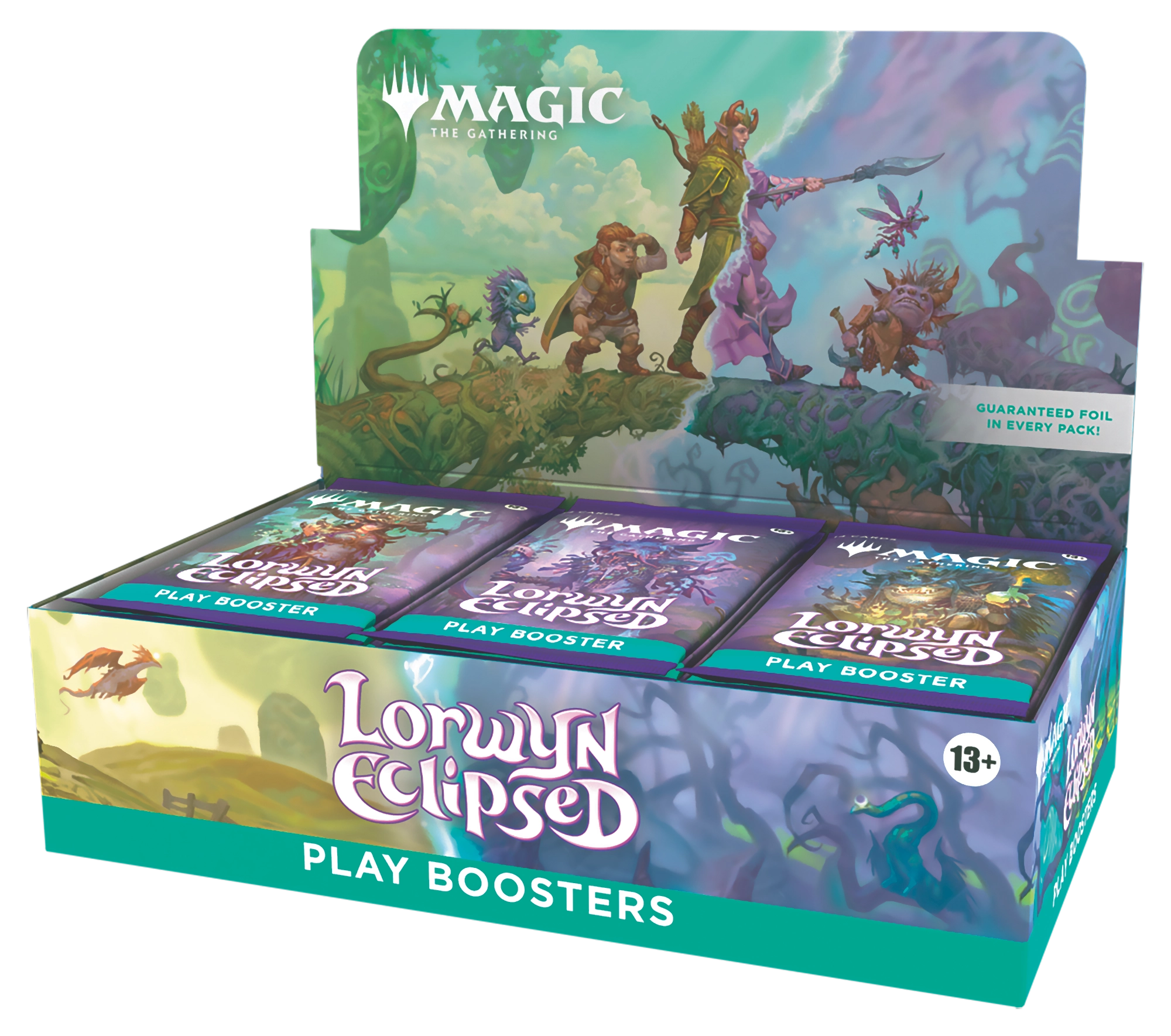
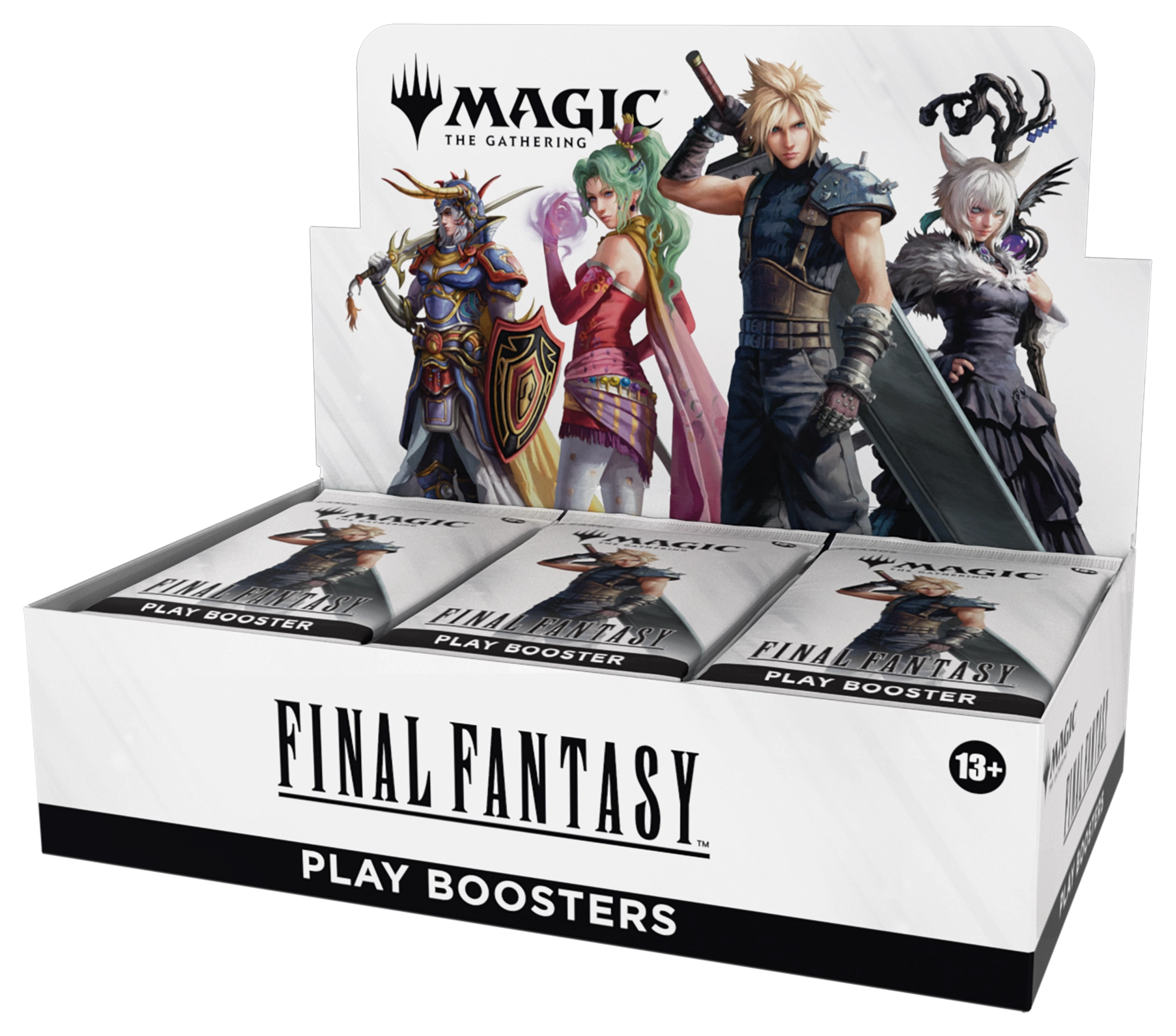
Official product images by Wizards of the Coast. Shown are boxes; the table compares single boosters and decks. FINAL FANTASY: © SQUARE ENIX.
A dollar MSRP is not a Dutch store price
Wizards does not determine what every Dutch store must charge. An MSRP is a suggested retail price; stores set their own selling prices. Moreover, you cannot place a US amount directly next to a Dutch consumer amount without taking currency, taxes, and regional costs into account.
For your own purchase, therefore, compare the same product, in the same language and version, including shipping costs. A sold-out offer is not a price at which you can actually order today. You can find more background in why Magic cards in the Netherlands cost what they cost.
Why the release tempo can feel so heavy
A booster may keep the same price while your annual expenses still rise. If there is a new set that appeals to you more often, there are also more moments to make a purchase.
major set releases
major set releases announced
The seven major releases of 2026 are Lorwyn Eclipsed, Teenage Mutant Ninja Turtles, Secrets of Strixhaven, Marvel Super Heroes, The Hobbit, Reality Fracture, and Star Trek. Wizards calls 2026 an anomaly in scheduling and announced a return to six for 2027. Secret Lair drops and other supplemental products are excluded from this count.
Source: the official announcement of the line-up.
Universes Beyond is not just for collectors. Since Final Fantasy, major crossover core sets have also been part of Standard. That doesn't mean every associated Commander product or every bonus card is automatically Standard-legal, but it does mean such releases change the card pool of regular formats.
Wizards explains this direction in The Foundations of Magic's Next Era.
My objection isn't to a fan who gets excited about Cloud or a hobbit. New players and new ideas can actually add something. But “then don't buy it” is only part of the answer if your opponents do play those cards. You can skip a purchase and still need time to get to know the new cards.
Hype and scarcity reinforce each other
Previews, special editions, and reports of sold-out stock can make it feel like you have to decide immediately. That fear of missing out is often called FOMO. A shortage can be real, but an empty store inventory doesn't tell you whether a product is gone everywhere or will never return.
Scalping can increase that pressure. Yet a high price in itself is not proof of scalping: demand, procurement costs, and limited supply also play a role. I elaborate on that distinction in my article about scalping in MTG.
Record revenue doesn't tell the whole story
Hasbro reported revenue of approximately 1.72 billion dollars for Magic in 2025, 59% higher than in 2024. The commercial success is therefore clear. This is reported revenue for Hasbro, not profit, and also not a sum total of what consumers worldwide paid at stores.
Source: Hasbro, results for the fourth quarter and the full year 2025.
From that revenue figure alone, you cannot deduce how much more expensive the average deck has become. More products sold, different types of products, and new buyers can all contribute. Nor does record revenue prove that every player is satisfied. A brand can sell excellently while some existing players drop out due to price or tempo.
What I notice as a small retailer
On the procurement side, I experience the price pressure too. For certain products, my purchasing costs rise, and with popular releases, the allocation can be smaller than what I want to order. Such an allocation determines how much inventory I actually receive.
A higher retail price therefore does not automatically mean I keep more. Payment processing, packaging, business operations, and my time must also come out of the room between purchasing and selling. Meanwhile, inventory that sells slowly ties up money.
That is my experience at SpellArmory, not a statement that every store has the same costs or margins. And it is also no free pass for any price. As a customer, you have the right to compare and decide that something is too expensive for you.
I set my store prices myself. What I want to offer is a price that is reasonable for you and with which I can keep this small store running healthily. Sometimes a cheaper product fits your goal better. Sometimes you already have enough cards and buying nothing is the best choice.
Six ways to keep Magic more affordable
There is no purchase that is the best solution for everyone. First, look at what you want to do: play together, improve, draft, or collect. After that, you can make much more targeted choices.
1. Use a fixed deck longer
A Commander precon is a complete deck you can play with immediately. You don't have to replace it after every set. Because Commander has no periodic set rotation, your cards can remain usable for a long time.
"Buy once and you're set forever" goes too far, though. A ban may require adjustments and a playgroup might start playing stronger. A precon is also not automatically a good match for heavily optimized decks.
Therefore, agree to regularly play with unmodified precons, for example. Then you keep the costs and expectations manageable together. If you are looking for your first deck, start with Commander precons for beginners.
2. Buy a solution for your deck, not every new staple
After a few games, write down what you are missing. Are you drawing too few cards? Are you short on mana? Do you have hardly any answers to big threats? Choose a few cards that solve that problem.
For a specific card, a single gives you certainty about what you are receiving. With random boosters, you don't have that certainty. In doing so, also compare shipping costs and card condition; ten cheap cards from ten sellers can turn out to be expensive together.
A cheaper card can fulfill the same role without being just as efficient. At a relaxed Commander table, that is often fine. In competitive play, that difference might weigh more heavily; there it helps to view the costs of a complete decklist beforehand.
3. Pay consciously for the version you want
A regular version and a foil or borderless version of the same card have the same gameplay effect. You may love that special version, but your deck doesn't need it to be able to play the card.
Reprints can make more affordable copies available. They just don't guarantee a price drop: demand can also increase, and a rare old version can maintain its own collector market. So, don't wait for an imaginary fixed bottom price.
The same applies to boosters. Someone who just wants to draft needs a different product than someone looking for specific collector variants. The explanation of booster types helps to keep those choices separate.
4. View Draft as an activity with a total price
Draft can be a fun way to combine opening cards with a game night. You don't have to bring an expensive tournament deck beforehand. But “dirt cheap” is not a feature of the format: entry, set choice, travel, and how often you go all count.
A calculation example: if an evening costs you €24 in total and you play for four hours, that's €6 per hour. That isn't an average market price; it just shows how you can compare your own evening with other activities. Do not count a potential expensive pull as a discount in advance.
Do you want to draft often without using new boosters every time? A cube is a reusable collection of cards with which you draft again and again. You can start with cards you already have. The composition and preparation do cost time. Read how to build your own cube.
5. Make budget agreements with your playgroup
An affordable hobby is easier if you aren't the only one stepping on the brakes. Agree on a precon night, lend a deck to a new player, or choose a limit for upgrades together. Also establish what you will do with more expensive cards that someone already owns.
For casual games, you can agree to use clear playtest cards. That is not an automatic right just because someone says "Rule 0": ask in advance whether everyone and any organizer agrees. Use recognizable substitutes that do not pass for real cards.
For sanctioned tournaments, different rules apply. Self-made playtest cards are not a replacement for permitted real cards there. There are limited exceptions for proxies provided by a judge in accordance with tournament regulations.
Sources: Wizards on playtest cards and proxies and the official tournament documents.
6. Give playing and collecting their own budget
Opening boosters because you enjoy it is a fine hobby choice. It becomes unclear if you have to justify every box to yourself as a necessary deck upgrade.
Choose an amount that works for you and divide it between playing, singles, and collecting. Also reserve space for sleeves or a game night. You don't have to spend that budget. And money you might get back by selling cards, I would only count once that sale has actually taken place.
Tip from SpellArmory
Before a release, put three things on paper: which product or card you really want, what you want to spend at maximum, and what you are going to use it for. Does the price not fit? Save the wish on your list. A new announcement is not an agreement with your wallet.
My honest opinion: less buying pressure, more room to play
I think it is justified that players are critical of the costs and the tempo. A choice between seven attractive releases is still a choice that costs attention and sometimes disappointment. And for some players, certain products or formats have simply become out of reach.
FOMO can reinforce that, but it is not the only cause. "You're letting yourself be rushed" is therefore too easy as an answer to someone who sees their trusted hobby becoming more expensive.
What I do hope is that we keep room at the table for different budgets. You don't need to own an expensive version to be allowed to be enthusiastic about Magic. A newcomer with a precon deserves a suitable game, not a grocery list of mandatory upgrades.
My advice remains to choose consciously, but without placing the responsibility solely on the buyer. Wizards determines which products it releases and at what suggested retail prices. Stores make choices about their supply and prices. Playgroups decide together how much pressure is created at the table to keep up.
For me, a successful Magic night is one where you find yourself wanting to play just one more game.
If your deck already delivers that, you might not need anything new this month at all.
Not sure what fits your budget?
Tell me what you want to play, what you already have, and what you’re struggling with. I can help you think through a suitable product or a smaller adjustment. Feel free to send me a message.
Read more
- How Dutch Magic prices are determined
- Scalping in MTG: scarcity, purchasing pressure, and conscious choices
- Choosing a suitable Commander precon
- Protecting and storing your cards
Sources and notes
The figures and product details were verified in September 2026. The dollar amounts mentioned are official US recommended retail prices, not special offers or Dutch retail prices.
- Wizards: Magic Returns to Listing MSRP with Foundations — recommended retail prices, the amounts for Aetherdrift, and the freedom of stores to set their own prices.
- Wizards: Collecting Lorwyn Eclipsed — product details, images, and the announced price changes.
- Wizards: Collecting FINAL FANTASY — the product details and recommended retail prices for this crossover.
- Wizards: Everything Announced for Magic in 2026 — seven major releases in 2026 and the six announced for 2027.
- Wizards: The Foundations of Magic's Next Era — the status of new Universes Beyond main sets in Standard.
- Hasbro: Full-year 2025 results — the reported Magic revenue and growth.
- Wizards: On Proxies, Policy, and Communication and WPN tournament documents — the distinction between casual playtesting and sanctioned play.
The experiences regarding purchasing and retail operations reflect my own perspective at SpellArmory. The budget choices and assessment of the release pace are my own opinion. This article contains no prediction that cards or sealed products will increase or decrease in price.

Written by Omèr Cremers
Owner of SpellArmory, social worker, and full-time dad. A fanatic MTG player and collector from Maastricht — Commander is my favorite format. Questions about which product suits you? Feel free to send me a message.