

In a nutshell
- A cube is a custom card pool that you can draft from time and time again.
- 360 cards is a practical size for eight players, each with three packs of fifteen. For a smaller group, a smaller cube might be a better fit.
- After the session, everything goes back in the box. You don't need to buy new boosters for the next evening.
- Singleton, rarity, and theme are design choices. Your cube does not have to consist exclusively of expensive or exceptionally strong cards.
- In addition to the cards, also count on basic lands, matching sleeves, tokens, and a suitable storage box.
Drafting is, in my opinion, one of the most enjoyable ways to play Magic: choosing cards, discovering a plan, and building a deck on the spot. With a cube, you turn that experience into a reusable game for your own group.
You choose which cards are included. These could be favorite commons, cards from a single world, or a collection of powerful rares. The challenge isn't to combine as many good cards as possible, but to create an environment in which multiple fun decks can emerge.
Read on to learn how to set up your first cube, what you need, and how to play with it—with eight players, as well as with two, three, or four.
What exactly is a cube?
A cube is a collection of Magic cards that you assemble to draft or play other Limited game formats. In a classic Cube Draft, you create packs yourself, players choose cards from them, and then they build a deck of at least 40 cards, supplemented with basic lands.
The most important difference from a regular booster draft: the cards remain part of the cube. After playing, you take the decks apart and the collection goes back into the box. You don't keep the cards you've chosen.
Tip from SpellArmory
Are you not yet familiar with choosing cards and passing packs? First read Drafting explained. This guide focuses primarily on assembling and reusing your own draft environment.
What is fixed, and what do you choose yourself?
- Singleton is common, but not mandatory. One copy per card name provides plenty of variety. Extra copies can actually help support a specific theme or a mana base.
- Your cube does not have to be a multiple of 45. For three packs of fifteen, you need 45 cards per player; the remaining cards can stay in the box that evening.
- There is no universal Cube banlist. The creator decides which cards are included and explains any house rules in advance. The regular Magic rules remain the starting point.
In this guide, I am referring to a cube for standard one-on-one games. A Commander cube requires extra choices regarding commanders, color identity, deck size, and the drafting process itself; do not automatically use the same template for that.
What does a cube actually cost?
The advantage is clear: you don't buy new boosters for every gaming session. That doesn't automatically mean a cube is free or paid off after a set number of evenings.
| Regular booster draft | Cube Draft |
|---|---|
| At the usual draft with eight players: 24 suitable boosters. | You use the same card pool over and over again. |
| New expenses on boosters every night. | Expenses for missing cards, sleeves, and storage; later possibly replacement and updates. |
| The opened cards are distributed afterwards according to your agreements. | All cards go back to the owner of the cube. |
| You play the draft environment of the chosen set. | You play an environment that you can customize yourself. |
Compare the price of 24 boosters, not necessarily that of an entire box. The number of boosters per box varies by product. You can read more about this in the different booster types.
A calculation example, not a price promise
Suppose you spend €180 on missing cards, sleeves, and a box. Also suppose 24 boosters for your normal evening cost €96. Two skipped booster purchases then total €192.
That only compares the joint expenses. It does not take into account the cards you get at a booster draft, the value of your existing collection, maintenance, or who pays the bill. So, use your own amounts.
My advice: determine a budget in advance and start with cards you already have. Then buy targeted missing pieces. A cube doesn't have to be upgraded with every new set.
How big should your cube be?
Choose based on the group that is actually at the table. The numbers below apply to three packs of fifteen per player, not for every possible draft variant.
| Cube | Example | What does that mean? |
|---|---|---|
| 180 cards | 4 players: 180 cards | Everything is used. Also usable for two-player variants. |
| 360 cards | 8 players: 360 cards | Everything is used; a clear starting point for a full table. |
| 450 cards | 8 players: 360 cards | 90 cards, or 20%, stay out of this draft. |
| 540 cards | 8 players: 360 cards | A third stays in the box. Specific combinations appear less reliably. |
| 720 cards | 8 players: 360 cards | Half is used. There are also enough cards for two separate tables of eight. |
My advice: choose 180 if you mainly play with two to four, and 360 if you regularly gather a larger group. A compact cube of around 180 cards is often called a Twobert; this is not a separate drafting method.
More cards provide more variety, but also require more attention to the availability of your themes. A larger cube is not automatically more expensive, stronger, or worse in balance: that depends on your card choices.
Which type of cube suits your group?
- Pauper: only cards that qualify as common within your chosen rarity agreement. Agree, for example, on whether a digital common print counts. A Pauper cube does not automatically follow the Constructed Pauper banlist.
- Peasant: commons and uncommons. You get more options, but rarity alone does not determine how strong or complicated a card is.
- Unpowered: usually without the Power Nine and often without other extreme outliers. This does not mean "without Reserved List cards." The precise boundary varies by builder.
- Powered: with cards like the Power Nine and an environment that supports such powerful effects. This can be physical or digital; "powered" does not simply mean that there are many rares in it.
- Theme or set cube: for example, around Innistrad, artifacts, or a favorite set. A set cube can deliberately use multiple copies to better approach the original draft.
For a first budget cube, I would look at pauper, peasant, or a custom price limit per card. None of these choices guarantee balance: a cheap common can still be too strong in your environment.
A practical building scheme for 360 cards
Start with a distribution on paper before adding your favorite cards. This is my suggested starting model, not an official standard or tested guarantee. It keeps the multicolor section limited and deliberately reserves space for lands.
| Component | Quantity | Content |
|---|---|---|
| White, blue, black, red, and green | 250 | 50 per color. |
| Multicolor | 30 | As a starting point, 3 per color pair. |
| Colorless cards | 30 | For example, artifacts that multiple decks can use. |
| Nonbasic lands | 50 | Mainly fixing, possibly supplemented with utility lands. |
| Total | 360 | Basic lands and tokens are kept separately. |
Count every card once. For example, an artifact with a colored mana cost belongs to that color. A colorless artifact with a blue activation cost can likewise be primarily a blue card for your design.
An equal number of cards per color is a useful starting point, but no proof of balance. Fifty powerful blue cards and fifty weak red cards do not yield equivalent options.
1. Take care of the basics first
Sort your existing cards by function: early creatures, interaction, card draw, finishers, and mana fixing. Keep cards that do something useful in a playable deck. "I have twenty of them" is not a reason in itself to include a card.
- A suitable curve: ensure decks can participate in the early turns. An aggressive deck also needs good one- and two-mana cards; a ramp deck can carry more expensive cards.
- Interaction: provide answers to the threats you add. That doesn't have to be the same removal in every color: bounce, counterspells, and combat tricks fulfill different roles.
- A way to win: a deck full of answers or fun triggers still needs pressure, finishers, or another clear win condition.
- Sufficient fixing: support the color combinations you expect from players. Many gold cards without matching lands mainly result in unplayable hands.
2. Connect the themes
You can choose a direction per color pair, but don't create ten closed puzzles. Cards that support multiple plans give players room to change course during the draft.
A token generator, for example, can be useful in an aggressive deck, in a sacrifice deck, and next to cards that reward having many creatures. That is more flexible than a card that only works when exactly one other card from the cube is also found.
Tip from SpellArmory
When considering a notable addition, ask: "Which decks want this card, and are the necessary partners available often enough?" If you put a narrow combo in a cube of which only half is used, an essential component might remain in the box that night.
Four cards that clarify the design
These examples show which role a card can fulfill. It is not a mandatory shopping list. Thraben Inspector and Evolving Wilds have common versions; Young Pyromancer and Blood Artist fit in a peasant cube, for example.
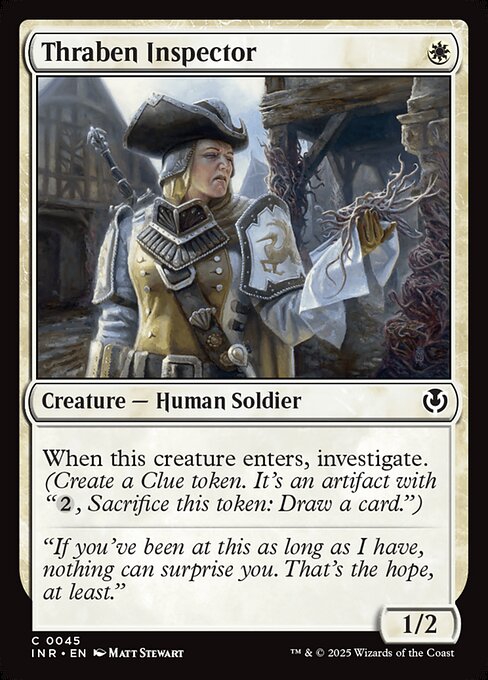
Thraben Inspector: multiple functions
An early creature that creates a Clue. The Clue offers a card later for two mana and can be relevant for artifact themes. The enter-the-battlefield ability also makes the Inspector interesting for blink effects.
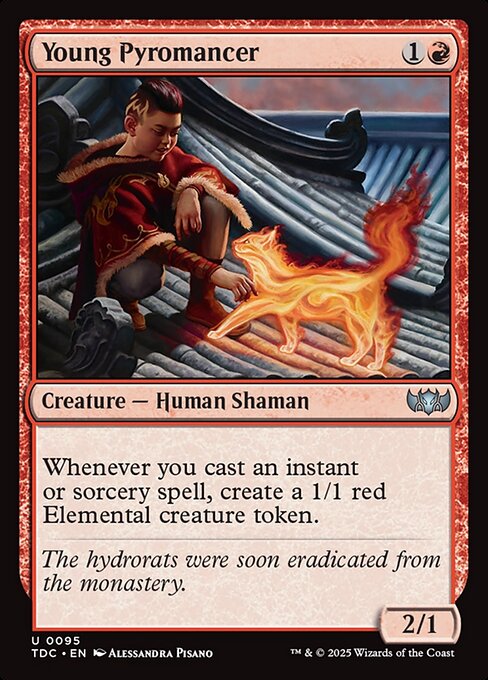
Young Pyromancer: spells become creatures
Every cast instant or sorcery yields a 1/1 Elemental. That supports a spells deck, but the tokens can also attack, block, or be sacrificed.

Blood Artist: a reward for dying creatures
Whenever he or another creature dies, a chosen player loses one life and you gain one. He can thus support both creature combat and a sacrifice plan.

Evolving Wilds: fixing with a trade-off
Searches for a basic land of choice that enters tapped. You trade one land for another: this helps your colors, but does not provide an extra land on the battlefield by itself.
Card images via Scryfall. Cards and illustrations © Wizards of the Coast and respective rights holders.
The cohesion lies in the functions: Young Pyromancer makes creatures that a sacrifice plan can use; Blood Artist rewards dying creatures; Thraben Inspector supports, among other things, blink and artifact themes. You don't have to play these cards all in the same deck.
Pay attention to the environment too. Blood Artist is not a sacrifice outlet: you still need a way to sacrifice creatures yourself if that is your plan. Evolving Wilds helps your colors, but the basic land found enters tapped. A lot of slow fixing can disadvantage fast decks.
How to organize your first draft night
- Explain the agreements. Tell people which themes and special cards are included. All cards are returned afterwards.
- Randomize the cube thoroughly. Work with smaller stacks if necessary and mix them repeatedly. Dealing out piles is not a full substitute for shuffling.
- Make the packs. For eight players, that is 24 packs of fifteen; for four players, 12 packs. Start simple with random content.
- Draft left, right, left. Everyone chooses one card at a time and passes the rest. Finish each pack before the next round starts.
- Build your deck. At least 40 cards; approximately 17 lands and 23 other cards is a starting point, not a requirement. Add regular basic lands from the common supply.
- Play and clean up together. Save unused picks as a sideboard. Count the cube afterwards and separate basic lands and tokens again.
A singleton cube does not force you to play singleton if there happen to be duplicate cards in your draft pool. In regular Limited deck building, you may use all copies you have drafted, unless you agree otherwise in advance.
Don't forget the basic lands
Eight decks with seventeen lands each require approximately 136 lands together. Twenty basic lands per color is only one hundred in total and is therefore a tight supply, even though drafted nonbasic lands compensate for part of it.
My practical starting point is 40 basic lands of each color: 200 in total. Adjust that if your group often plays many of the same color. Regular basic lands are not usually drafted; special lands or house rules should be agreed upon separately.
Cube with two, three, or four players
You don't need to wait for eight players. However, do choose a draft format that suits your group; a theme that emerges smoothly with eight players can be less reliable with a smaller card pool.
Grid Draft with two players
Take 162 random cards: eighteen grids of nine.
- Place nine cards face up in a 3×3 grid, in the order they come off the stack.
- Player one takes one full row or column: three cards. Diagonals do not count.
- Player two takes a row or column from what remains: two or three cards.
- Set the rest aside for this draft. Do not refill the grid in between.
- Create a new grid and switch who starts. Repeat until all eighteen grids are finished.
| A | B | C |
| D | E | F |
| G | H | I |
Each letter is one card. If player one chooses A–B–C, player two can choose, for example, D–E–F, or the remaining middle column E–H.
Grid Draft with three players
Use eighteen grids and 216 cards. After the first choice, you refill the three empty spots. Player two then chooses three cards; after that, player three chooses a remaining row or column, without refilling again. Set the rest aside and rotate the starting player.
After drafting, add basic lands and build decks of at least 40 cards. You can play one-on-one matches with each other and keep rotating who sits out.
An alternative for two: Winston Draft
Winston uses more hidden information. Take 90 random cube cards and shuffle them.
- Set aside three cards as three face-down stacks of one card each. The rest is the draw pile.
- During your turn, look at the first stack. Take it entirely, or put it back and add one card from the draw pile to it, unseen.
- If you take the stack, fill the empty spot with one new card and end your turn.
- If you pass on it, make the same choice for the second and, if applicable, third stack.
- If you also pass on the third, add a card to it and then take the top card of the draw pile for yourself.
- Take turns until all cards have been distributed. Only add cards as long as the draw pile allows; after that, distribute the remaining stacks as well.
Not everyone ends up with the same number of cards. Build a deck of at least 40 cards using your own pool and additional basic lands.
With four players
A regular draft with three packs of fifteen per person uses 180 cards: exactly half of a 360-card cube. Packs come back to you more often than with eight players. Therefore, ensure there are enough cards that are useful in multiple decks.
Do you want to build decks immediately without drafting? Try Cube Sealed: give everyone, for example, ninety random cards and add basic lands. With four players, that uses a whole 360-card cube.
Sleeves, storage and maintenance
Count your basic lands too
Sleeves are not a general Cube rule, but I strongly recommend them. Use opaque sleeves of the same brand, type, and color for the cube AND the basic lands. Check whether differences in wear or production batches make cards identifiable.
With 360 cube cards and 200 basic lands, you sleeve 560 cards. Six packs of one hundred then provide forty spares. If you also want to sleeve tokens or double-sleeve, count that separately. For choosing materials, see Dragon Shield vs Ultimate Guard.
Choose a box based on the specified capacity for sleeved or double-sleeved cards. Leave room for basic lands, tokens, and dividers. There is no reliable universal conversion from 360 sleeved cards to a fixed number of unsleeved cards.
Improve based on what your group notices
After playing, note down a few concrete things: which decks didn't get off the ground, which cards were left without useful partners, and which games felt one-sided? A single early pick or win does not prove a card is a problem.
- Color issues? Look at fixing, the number of colors per deck, and heavy colored mana costs together.
- Nobody plays aggro? Check the cheap creatures and whether the rest of the cube stabilizes too easily.
- A theme isn't working? See if both the supporting cards and the rewards appear often enough.
- Always the same unpleasant card? Discuss what that card does and if appropriate answers are present.
Tip from SpellArmory
First, change a small, cohesive group of cards and write down what you want to solve with them. A hard limit of five or fifteen changes isn't necessary; the point is that you still understand afterwards which change improved something.
Starting with an existing list
You don't have to design everything yourself. On Cube Cobra, you can view existing cubes, manage your own list, and try out drafts. Choose an example that fits your number of players, budget, and desired complexity.
Don't just copy the card names: also read the creator's explanation. Which themes are supported? Are there duplicate cards or special draft rules? If possible, replace missing cards with something that has the same function, so the plan remains intact.
My advice for your first version: make something your group can actually play. You don't have to find the ideal 360 cards first. A clear foundation, enough lands, and an initial evening at the table will give you a much more useful starting point.
Ready to assemble your cube?
Check out sleeves and storage options for your cards, basic lands, and tokens. Calculate your total required capacity before you choose.
Read also
- Draft explained
- All MTG booster types explained
- Protecting and storing Magic cards
- Playing MTG in Maastricht and Limburg
Sources and notes
The game rules have been verified with Wizards and sources from the cube community. The construction schedule, the basic land supply, and the budget approach are editorial advice from SpellArmory. The euro amounts are strictly a calculation example.
- Wizards — Building Your First Cube: the basics of cube, card selection, and design rules.
- Wizards — Booster Draft: draft order and Limited deck building.
- Wizards — Planar Cube Draft: an official example of a cube with a non-standard size and duplicate cards.
- Wizards — Winston Draft: explanation of the two-player variant.
- Riptide Lab — Types of Cubes: design choices and cube types.
- Lucky Paper — Grid Draft: game explanation for two and three players; the variant was designed by Jason Waddell.
- Ryan Overturf — The Proper Way To Do Two-Player Cube Drafts: the design of a Twobert for two to four players.
- Cube Cobra — official project information: managing, sharing, and drafting lists.

Written by Omèr Cremers
Owner of SpellArmory, social worker, and full-time father. Avid MTG player and collector from Maastricht — Commander is my favorite format. Questions about which product suits you? Feel free to send me a message.