

Content reviewed: .
- A good upgrade solves a problem. Think of having too little usable mana, an empty hand, or a plan that just doesn't get off the ground.
- You don't need to replace a set number of cards. Start with three to five targeted swaps, for example, and test how they change things.
- Assess what you're taking out, too. Adding a strong card doesn't help much if it means losing a necessary function.
- Use your own playgroup as a benchmark. Smoother gameplay and a clearer theme can be more valuable than maximum power.
A Commander precon is a ready-to-play deck of one hundred cards. You can start playing with it immediately, but after a few games, you'll often discover which parts you enjoy and where it falls short. That is a great moment to upgrade your precon.
There is no shopping list that makes every deck better. A token deck requires something different than a deck with large creatures or many instants and sorceries. In this guide, you will learn what you want to improve, which cards fit those needs, and what you can responsibly cut.
1. Choose what your deck needs to do better
First, play a few games with the original list. Then, write down your main plan in one sentence, for example: "I create many creature tokens and boost them for a big attack." With that, you can evaluate every potential upgrade.
Many precons support more than one direction. That gives you options, but sometimes you want to make one of those paths stronger. You can also try a different suitable commander from the box, provided the full deck list fits within that commander's color identity. A different commander can significantly change your priorities.
| What do you notice? | Check first | Possible approach |
|---|---|---|
| I miss early land drops | Number of lands, opening hands, and mulligans. | More reliable land drops; don't immediately replace lands with mana rocks. |
| My cards stay in my hand for too long | The mana cost of your spells and your early ramp. | Lower some of your costs or add suitable acceleration. |
| I have the wrong colors of mana | Which colors your early spells require. | Improve color distribution and fixing. |
| My hand keeps emptying | How reliably your draw works, even without your commander. | A suitable draw engine or drawing directly usable cards. |
| I can't answer threats | Which card types your existing removal hits. | Supplement the missing type of interaction. |
| I build up a lot, but don't close out the game | How your advantage ultimately converts into a win. | Strengthen your win-con and cut poorly supported side plans. |
A bad opening hand doesn't prove a design flaw. Look for recurring problems. If your commander is constantly being removed, protection might help; if you play them too early without follow-up, a different timing might already make a difference.
2. Determine which cards from your precon can go
Sort your list by function: lands, ramp, card draw, interaction, protection, cards that make your theme work, and cards that can close out the game. A card can have multiple roles, but assess whether you are actually utilizing those roles.
Start with these potential cuts:
- Expensive cards with little immediate payout. What happens if you play the card while you're behind?
- Cards for a side plan you are abandoning. Don't just remove the reward, but also check if support cards lose their usefulness.
- An overcrowded role. If you already have many expensive finishers, a draw card might add more than another big attacker.
- An effect that is rarely relevant at your table. A card can be good and still not fit the decks you are playing against.
Don't automatically cut the most expensive creature or every land that enters tapped. A reanimation deck might actually want those expensive creatures back, and a land can have a useful function in addition to mana.
Tip from SpellArmory
For every swap, note: "This card goes in because…; this one goes out because…" Can't finish both sentences? Test the original card a little longer. Keep your old deck list and set the removed cards aside.
3. Improve your mana before adding more expensive cards
Ramp increases the mana you have available. Fixing helps you generate the right colors. Those functions sometimes overlap but are not the same: colorless mana does not pay for a white mana symbol.
A two-mana rock can get you to four mana on turn three, provided you make your land drops. That makes cheap ramp attractive, but a more expensive card might fit better if your deck utilizes its extra function. Also, check which ramp is already in the box.


What can go? For example, a slow ramp card whose extra function you don't use. Or a redundant expensive spell when you actually have too little mana development. A mana rock is no reason to cut a land without further verification: you need to be able to cast the rock first.
Improve the lands you already play
Look at which colors you need in the early turns. A card requiring two blue mana has different requirements than one with a single blue symbol. Preferably, replace lands land-by-land and maintain enough sources of every required color.
A basic land can be a fine improvement if another land keeps entering tapped without useful compensation. Conversely, a colorless land with a fun ability isn't automatically better than a colored source. Land ramp also requires enough suitable search targets.
4. Choose card advantage that actually benefits your deck
A draw engine can provide cards repeatedly. A one-off draw spell gives you immediate new options. Both can be useful. Ask yourself primarily: does this card work even when my commander is missing or my battlefield has just been wiped?


These cards are not interchangeable solutions. Morbid Opportunist doesn't draw five cards when five creatures die at once. Idol of Oblivion does little if you only occasionally make a token. Look at what your deck does often, not just what it can do in the ideal game.
Also note the difference between drawing cards and actually ending up with extra cards. Demand Answers lets you draw two cards, but requires discarding a card or sacrificing an artifact in addition to the spell. Using a superfluous token might fit your plan better than throwing away a useful card from your hand.
What can go? A draw card with a condition you rarely meet, or a card that primarily adds advantage when you are already well ahead. Don't remove all your independent draw just because your commander can also provide cards.
5. Choose appropriate answers and protection
View your interaction as a whole. Can you deal with a dangerous creature? And an enchantment, artifact, or graveyard? You don't need an answer for everything at once, but six variants of the same creature-removal effect won't solve every problem.
- A broad answer: Generous Gift destroys a permanent and gives the controller a 3/3 Elephant. It is flexible, but destroying doesn't work against indestructible.
- Interaction with graveyards: Soul-Guide Lantern exiles one card from a graveyard upon entry. Afterwards, you can tap and sacrifice it to exile all opponents' graveyards, or pay one mana, tap, and sacrifice it to draw a card. Those are two separate choices.
- A board wipe: helps when one targeted answer isn't enough. Choose the effect consciously: does it also hit your setup, and can you continue playing afterwards?
An answer you can use at instant speed provides flexibility. For that, however, you must keep mana available. When in doubt, read the explanation of the stack and priority.
Protection is not the same as invulnerability
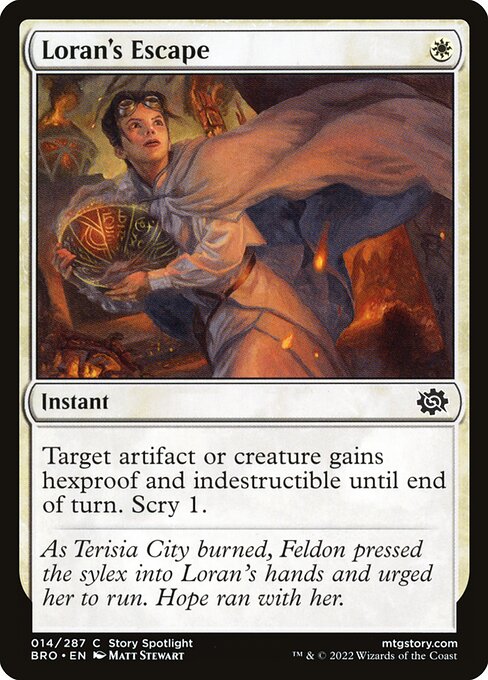
Loran’s Escape can help against an opponent's targeted removal and against destruction. It won't save your creature from an effect that exiles all creatures, forces sacrifice, or a toughness reduction to zero or less. Choose protection against the effects you actually encounter.
Does your entire deck stall without your commander? Then, in addition to protection, a second card with a similar function might help. If your deck functions independently, you might benefit more from extra draw than another protection card.
What can go? An answer that repeats an already well-covered role, or protection that doesn't align with the threats at your table. Maintain a usable mix.
What a targeted upgrade looks like
Fictional example: you are playing a green-white token deck. You create tokens regularly, but your hand empties out. Furthermore, you have too many expensive creatures and few answers to enchantments. The choices below show how you can work on that in a targeted way; this is not a deck list for a specific precon.
| Potential card out | Candidate in | Why this swap? |
|---|---|---|
| An expensive creature that does little with tokens | Idol of Oblivion | Your existing token production helps keep your hand filled. |
| A slow ramp card with no useful extra function | Nature’s Lore | Earlier mana development, provided you play enough suitable Forest cards. |
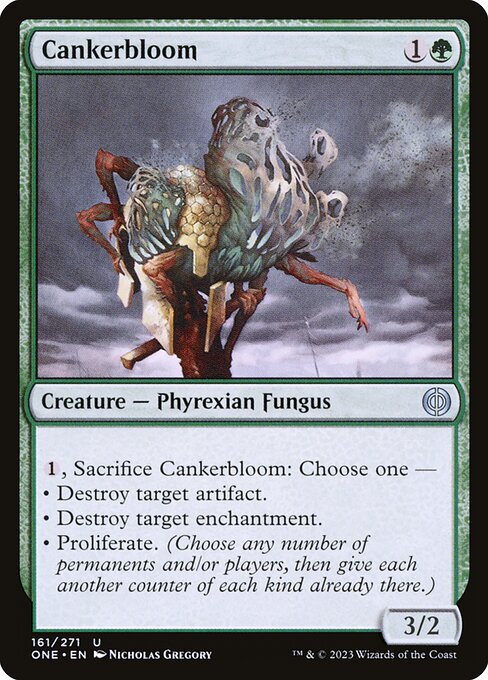
| A poorly supported card for a side plan | Cankerbloom | Adds artifact and enchantment interaction; proliferate is only a bonus if you use relevant counters. |
Check first whether these cards are already in your list. Then test if you can actually keep playing more often. Is the mana working well already? Skip the ramp swap. Missing a way to get through blockers? Then look into trample, evasion, or a suitable boost to your attack.
Tip from SpellArmory
Keep enough cards that execute your plan. If you cut a token maker for every good draw or removal card, your token deck will soon have too little fuel. A better support card only helps if the rest of the deck continues to work with it.
Budget and power level: determine your limit in advance
My advice: spend your initial upgrade budget on the problem that hinders you the most often. Three functional improvements can yield more than one expensive well-known card. The most expensive version of a card also doesn't play stronger than a regular printing of the same card.
Check your collection and the original deck list before you buy anything. Then compare the total price including shipping. If you want specific upgrades, buy them as singles; boosters do not guarantee you will open the cards you need. There is no fixed amount for which every precon becomes optimal.
An upgrade does not automatically determine your Commander Bracket
More money spent or more cards replaced does not automatically mean a higher bracket. Wizards has decoupled precons from a fixed place in Bracket 2. Evaluate what the whole deck does and discuss the desired play experience with your group.
For major changes, check the current Game Changers list and bracket expectations, for example with fast combos or strongly accelerating cards. Game Changers are not a ban list. Read the guide on Commander Brackets and the unspoken rules of the gaming table for the conversation beforehand.
Check your list and test in small steps
For a regular Commander deck, the deck-building rules remain: exactly one hundred cards including your commander or commanders, maximum one copy per card name outside of basics and permitted exceptions, and cards within your commander's color identity. Also check the current Commander ban list.
My practical starting point is three to five swaps per test round. That is a method, not a rule of the game. If you are replacing a complete side plan, more cohesive changes may be necessary.
- Mana: are you making your early land drops and can you make the necessary colors?
- Cards: does your draw work even without your commander or if you are behind?
- Interaction: can you respond to the threats you encounter?
- Game plan: does your build actually help you close out a game?
- Fun factor: does the deck still feel like yours and does it fit the playgroup?
You can play through a few opening hands and early turns by yourself beforehand to identify glaring mana issues. That doesn't replace real games: without opponents, you can't tell if your protection, removal, and recovery after a board wipe are good enough.
Don't just judge by games won. A deck that participates more often and stalls out less often may already have been significantly improved. Isn't a swap working? Put the old card back and try something else.
Frequently asked questions about upgrading precons
Should I upgrade a new precon immediately?
No. Play it as it is first. This way, you'll discover which cards work well together and if the theme suits you. Upgrading is an option, not a mandatory extra purchase.
How many cards should I replace?
As many as needed for your goal. Sometimes a few swaps help; for a different commander or a new main plan, a larger overhaul might be necessary. The number of replaced cards is not a measure of your deck's quality.
Can I just add the most popular cards?
Use popular cards as candidates. Afterwards, check color identity, mana costs, conditions, synergy, and what you have to remove for them. A card with many recommendations might still be a poor fit for your list.
When is a different precon a better choice?
If you are actually looking for a completely different playstyle and would replace almost all the theme cards, compare the costs and game plan of another deck first. Check out the precon buying guide for beginners or the selection of Commander Decks.
Sources and card information
The rules have been verified with Wizards of the Coast. Card examples are based on the card text and current Oracle text via Scryfall. The upgrade order, selection criteria, and quantities per test round are editorial advice from SpellArmory.
- Wizards: current Magic rules — including Commander deck building, hexproof, and indestructible.
- Wizards: Commander, Brackets and Game Changers.
- Wizards: bracket update from February 9, 2026 — including explanations on precons and Bracket 2.
- Wizards: current banned & restricted lists — check under Commander.
- Gatherer is the official card database. The card links and clickable images in this guide open Scryfall.
Card images: Wizards of the Coast, displayed via Scryfall. The displayed printing is for illustration purposes; feel free to choose another version of the same card.

Written by Omèr Cremers
Owner of SpellArmory, social worker, and full-time father. Avid MTG player and collector from Maastricht — Commander is my favorite format. Questions about which product suits you? Feel free to send me a message.