

In brief
- The stack determines the order: what is placed on top last, is handled first.
- Priority determines who may act: you respond when it is your turn to perform a legal action.
- Everyone passes in succession? Only the top item resolves. After that, priority is given again.
- Not everything uses the stack: playing a land, mana abilities, and combat damage are key exceptions.
Your opponent wants to destroy your creature. You have an instant with which you can make it larger. Which card is handled first, and does it matter who plays something first?
Yes: the same cards can result in a completely different outcome depending on the order. Below, you can see exactly how that works. Are you brand new to Magic? Start with how Magic: The Gathering works.
Stack
What is waiting to be handled, and which item comes first?
Priority
Which player is currently allowed to cast a spell, activate an ability, or pass?
What is the stack?
The stack is a shared game zone where spells and most activated and triggered abilities wait to be handled. A new item is placed on top. If everyone passes in succession, the top item resolves.
This is called Last In, First Out: last on, first off. Casting a spell and letting that spell resolve are two different moments.
After everyone passes in succession, you perform only that spell or ability.
Among other things, lethal damage is processed. Waiting triggers go onto the stack.
The player whose turn it is gets the chance to act first again.
SpellArmory tip: handle one item at a time.
The stack is not emptied all at once. Players can respond again between two items. During the resolution of a spell or ability, no one has priority: you cannot interrupt the execution halfway through with a regular reaction.
Two cards, two different outcomes
For this example, we use Lightning Strike and Titanic Growth. Both are instants. You can normally cast them when you have priority.
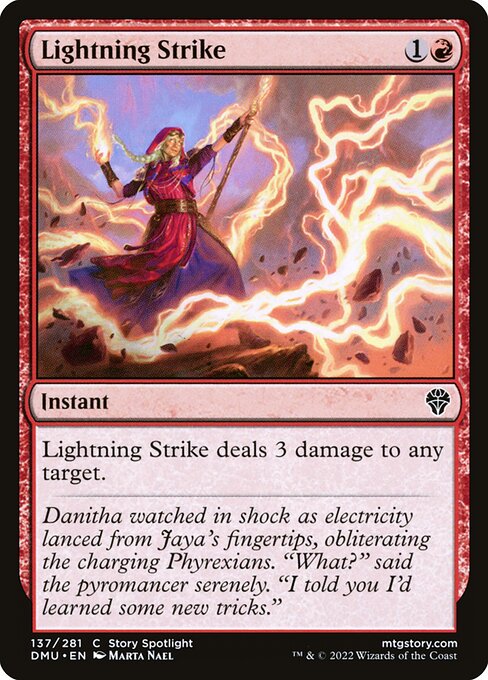
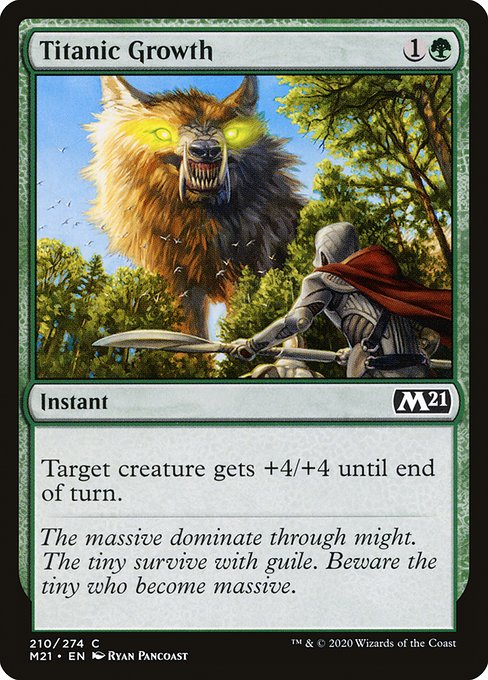
The starting situation: it is your turn, you are playing against one opponent, and you have an undamaged 2/2 creature. You both have enough mana. There are no other relevant effects or reactions.
You respond to the damage
Your opponent casts Lightning Strike. After they pass priority, you respond with Titanic Growth.
Between these two items, players receive priority again.
A 6/6 with 3 damage does not have lethal damage. Titanic Growth was in time.
Your opponent responds to the growth
You cast Titanic Growth and pass priority. Your opponent responds with Lightning Strike.
The creature dies before anyone receives priority again.
Titanic Growth no longer has a legal target and does not resolve.
Note: a 6/6 with 3 damage is not a 6/3. Regular damage does not reduce toughness; the damage remains marked on the creature until it is removed, usually during cleanup.
Situation A step by step, including priority
- You have priority and pass. Your opponent casts Lightning Strike on your 2/2 and passes priority.
- You cast Titanic Growth on that creature. The Growth is placed on top of the Strike.
- You pass and then your opponent passes. Only Titanic Growth resolves: your creature becomes a 6/6.
- After automatic checks, you as the active player receive priority again.
- You both pass again. Now Lightning Strike resolves and your creature takes 3 damage.
If you let the Strike resolve on your undamaged 2/2 first, responding with Titanic Growth is too late. The creature is destroyed by lethal damage before you receive priority again.
Priority: who can respond when?
Priority is the right to perform certain actions at that moment. For example, you can cast an instant, activate a legal ability, or pass. If you pass, priority goes to the next player in turn order.
The active player is the one whose turn it is. At the beginning of most steps and phases, they receive priority first, after automatic actions have been performed and any triggers have been placed on the stack.
If you cast a spell or activate an ability while having priority, you receive priority again afterward. You can therefore respond to your own spell before passing priority.
After the resolution of a spell or non-mana ability, the player whose turn it is receives priority first. First, the game processes automatic checks and waiting triggers.
Only when all players pass without taking an action in between does the top item resolve. If the stack is empty, the current step or phase ends.
SpellArmory tip: say “I hold priority”.
Do you want to respond directly to your own spell? Make that clear. According to common tournament conventions, it is otherwise assumed that you pass priority after placing something on the stack. Retaining priority allows you to add something; it does not allow your spells to resolve without others being able to respond.
Priority is not the same as permission for every card
You have priority
An instant or spell with flash can normally be cast at any moment you have priority, even during someone else's turn or with something on the stack.
You need three things
- Priority.
- Your own main phase.
- An empty stack.
This applies to sorceries and most permanent spells. Card text may make exceptions.
Playing a land can normally only be done during your own main phase, with priority and an empty stack, as long as you still have a land play available. Abilities can have their own timing restrictions. More about flash and other terms can be found in the MTG keyword guide.
What does and doesn't use the stack?
On the stack
- Spells: for example creatures, instants, and sorceries being cast.
- Activated abilities: recognizable by costs followed by a colon, except for mana abilities.
- Triggered abilities: usually recognizable by “when”, “whenever”, or “at”, except for triggered mana abilities.
Not on the stack
- Playing a land.
- Activating a mana ability.
- Paying costs, such as tapping or sacrificing.
- Declaring attackers and blockers and dealing combat damage.
- Static abilities and automatic checks, such as processing lethal damage.
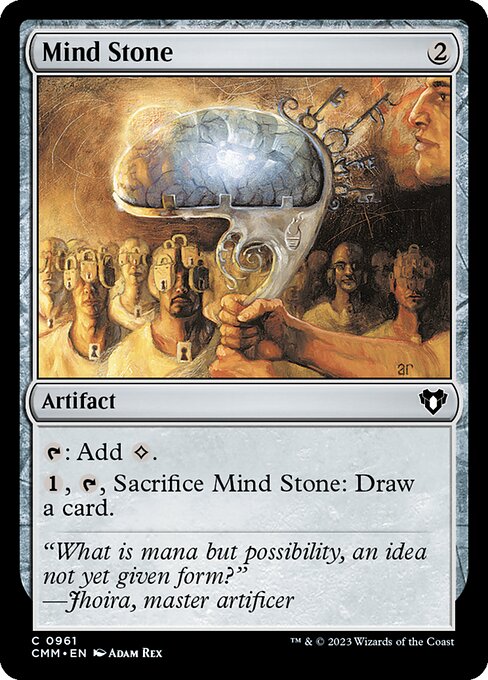
Mind Stone makes the difference visible
This is a mana ability. It does not use the stack and works immediately. An opponent cannot respond to this mana ability itself.
This ability does use the stack. You pay all costs immediately; Mind Stone is therefore already sacrificed before anyone can respond. You draw the card only when the ability resolves.
Because both abilities have tapping as a cost, you cannot simply use both with the same untapped Mind Stone.
The same distinction applies to a Forest and Titanic Growth: you don't respond to the mana ability of the land; you do, however, respond to the spell that is cast with that mana.
You also cannot interrupt playing a land. A landfall trigger that occurs as a result does go on the stack and can be answered as soon as you receive priority.
Priority during the turn: where can you respond?
A step often begins with an automatic action. That happens first. Then the game processes checks and any triggers, and the active player receives priority.
This is the normal turn structure. “Priority” means there is room for legal actions afterward; it does not mean you may play every card at that moment.
Beginning phase
You untap. Triggers that occur here wait until the next priority moment, usually in your upkeep.
First, any upkeep triggers go on the stack. You can act here before drawing your normal card for the turn.
First you automatically draw the card for your turn. Then priority follows.
First main phase
With an empty stack, you can also cast sorceries and most permanent spells, or play a land if you are still allowed to.
Combat phase
The last normal reaction moment before attackers are declared. Do you want to tap a creature to prevent an attack? Do that before declaring.
First, attackers are declared. Then any triggers and reactions follow.
First, blockers are declared. Then you can, for example, cast a combat trick, before combat damage.
First, damage is assigned and dealt. Creatures with lethal damage are handled before anyone receives priority again.
A final moment for reactions within the combat phase.
Second main phase
The same normal timing rules as during the first main phase.
Ending phase
Any end-step triggers go on the stack first. After that, the active player receives priority.
Discard down to your maximum hand size, remove damage, and end temporary effects. Priority only occurs here in exceptional situations.
Exceptions: first strike, double strike, and cleanup
First strike and double strike can result in an extra combat damage step. After that first damage, priority is received again before the regular combat damage.
Cleanup: if state-based actions are required or triggers are waiting, players can still receive priority here. A subsequent cleanup step follows.
Effects such as “until end of turn” normally end during cleanup, simultaneously with the removal of marked damage. Therefore, they do not end at the beginning of the end step.
Triggers and APNAP: the order in Commander
A triggered ability is normally placed on the stack just before a player would receive priority. If something triggers during the resolution of a spell, that trigger waits until the spell is completely finished.
Are standard triggers from multiple players waiting at the same time? Then APNAP: Active Player, Non-Active Player applies. First, the active player puts their own triggers on the stack; then the others follow in turn order. Each player chooses the order of their own triggers.
First on is not first off
The turn order is A, B, C, D. One event causes one standard ability to trigger for every player.
Putting them on the stack:
A → B → C → D
Resolving without new reactions:
D → C → B → A
Before each item resolves, everyone must pass sequentially again.
APNAP determines the order of placing triggers here. It is not a separate reaction round. As soon as all triggers are placed, in this example A as the active player receives priority. Subsequently, priority passes in turn order as players pass.
Five common mistakes
1. “I remove the creature, so the ability stops.”
An ability on the stack is independent of its source. Removing the creature does not remove the ability from the stack. It will still resolve as much as possible; targets and any conditions must still be valid.
2. “I respond to paying the cost.”
That is not possible. With the card-draw ability of Mind Stone, the artifact is already sacrificed by the time you can respond. You can respond to the ability, but you cannot prevent the costs from being paid.
3. “I tap your attacker, so it is no longer attacking.”
A creature that has already been declared as an attacker remains attacking if it is tapped or untapped afterwards. If you want to prevent the attack with a tapping effect, use it before declaring attackers.
4. “I hold priority, so no one can respond.”
Holding priority allows you to put something else on the stack. It does not skip opponents. Before the topmost item resolves, all players must pass sequentially.
5. “If I pass, I cannot respond to anything else.”
Passing applies to that specific priority moment. If someone does something afterwards, players get new opportunities to respond. But as soon as everyone has passed sequentially and the topmost item begins to resolve, you cannot interrupt that item.
Test yourself: can you still win at 1 life?
A and B are both at 1 life. It is A's turn.
- A activates a creature ability that deals 1 damage to B and passes priority.
- B responds with an instant that lets them draw a card. Both players let that spell resolve.
- B draws Lightning Strike and has enough mana to cast it.
- A does nothing further and passes priority.
Can B still win before the original ability deals damage? Assume no one responds further and there are no other effects.
View the answer
Yes. The original ability is still waiting on the stack.
- After the card-draw spell, A as the active player receives priority first.
- A passes. B receives priority and casts Lightning Strike at A.
- That spell is on top of the original ability. If both pass, the Strike resolves first.
- A drops to -2 life from 3 damage and loses during the subsequent automatic check.
In this two-player game, B wins before the original ability is handled. The key is the new priority moment after the card-draw spell. B did not receive that automatically first.
SpellArmory Tip: ask two questions at the table.
“What is on top?” and “Who has priority now?” These make most complicated situations much clearer. Then, clearly indicate whether you are responding or letting the top item resolve.
Video: more explanation from The Command Zone
Do you want to continue listening and practicing? The English episode A Masterclass in Priority & The Stack by The Command Zone covers the topic in detail.
Stuck during a tournament? Ask a judge for help. In a casual game, you can look up the card text and the rule together. Room for questions and clear communication are part of good etiquette at the MTG table.
More in SpellArmory Academy
- Commander explained — playing with multiple opponents.
- MTG deck archetypes explained — interaction within different playstyles.
- The MTG glossary — terms like removal, cantrip, and combat trick.
Rules and sources. Checked on September 26, 2026, against the official Magic rules, specifically 117, 405, 514, 603, 605, and 704. The tournament convention regarding holding priority is in §4.2 of the Magic Tournament Rules. Specific card texts may create exceptions.
Card images: Wizards of the Coast, displayed via Scryfall. Click on a card for the corresponding card version. The diagrams are simplified game situations under the stated assumptions.

Written by Omèr Cremers
Owner of SpellArmory, social worker, and full-time father. Fanatical MTG player and collector from Maastricht. Commander is my favorite format. A question or addition to this guide? Feel free to send me a message.