

Content checked: .
Some Magic players want to attack from the very first turns. Others keep mana open, build an army of tokens, or puzzle until two cards decide the game together. All these decks can be strong, but they feel very different to play.
Here you will learn to recognize and compare the most important MTG deck archetypes. First, we look at five common game plans. Then, we cover eleven popular Commander themes and building strategies, complete with real card examples. This allows you to choose a deck with more focus and better assess what your opponent is trying to do.
What is a deck archetype?
An archetype is a recognizable pattern in how a deck plays and attempts to win. That helps you make choices: do you want to apply early pressure, consistently trade cards favorably, or buy time for a decisive combination?
Players also use the word for themes like tokens or reanimator. That is fine in conversation, but it helps to distinguish between three questions:
- Format: which rules and allowed cards are you using? For example, Commander, Standard, or Modern.
- Game plan: how do you want to tilt the game in your favor? For example, aggro or control.
- Theme or engine: which cards work together for that purpose? For example, Zombies, landfall, or enchantments.
“A Commander deck with Zombies” therefore doesn’t yet tell you how it wins. It could win by attacking with an army, sacrificing creatures for life loss, or building up a combo. There is no mandatory classification where every deck fits into exactly one box.
Aggro, midrange, control, tempo, and combo at a glance
| Game plan | What is it about? | Typical decision while playing |
|---|---|---|
| Aggro | Applying early pressure and capitalizing on that lead. | Play another attacker or save mana to remove a blocker? |
| Midrange | Combining threats and answers, with room to switch roles. | Should I defend now or take over the offensive? |
| Control | Answering key threats and winning the long game. | Is this card worth my removal, or should I wait? |
| Tempo | Pushing an early threat with efficient disruption. | Can I win an attack with a cheap reaction? |
| Combo | Bringing cards together that collectively create a decisive effect. | Try to win now or wait until I can protect my combination? |
The cards below illustrate the plan. They do not form an actual tournament decklist and are not allowed in every format. Check the legality for the format you are playing.
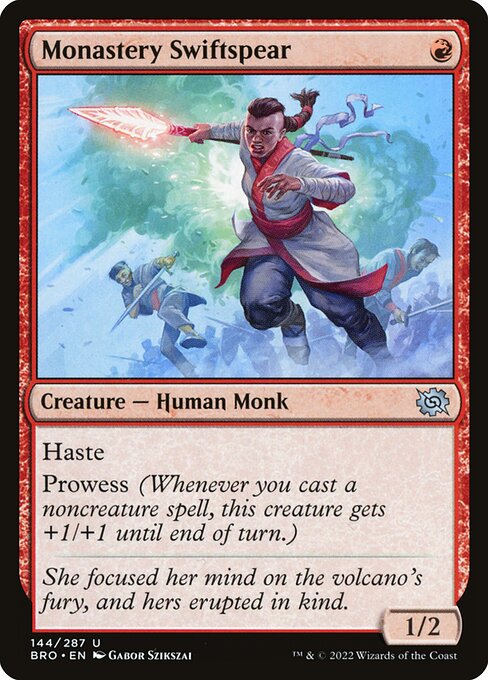
Aggro: put the opponent under early pressure
Aggro tries to capitalize before a slower deck can deploy its strongest cards. You often play cheap creatures, supplemented by damage spells or removal that clears the path. Monastery Swiftspear fits this: haste allows for immediate attacks, and noncreature spells can make her stronger temporarily.
Fits you if: you like taking the initiative and planning combat. The challenge lies in calculating damage, choosing when to commit, and avoiding being left with nothing after a board wipe.
In Commander, you usually have to defeat multiple players with forty starting life each. A few small attackers therefore need more support than in a duel. Tokens, commander damage, or effects that hit multiple opponents can help build that plan.
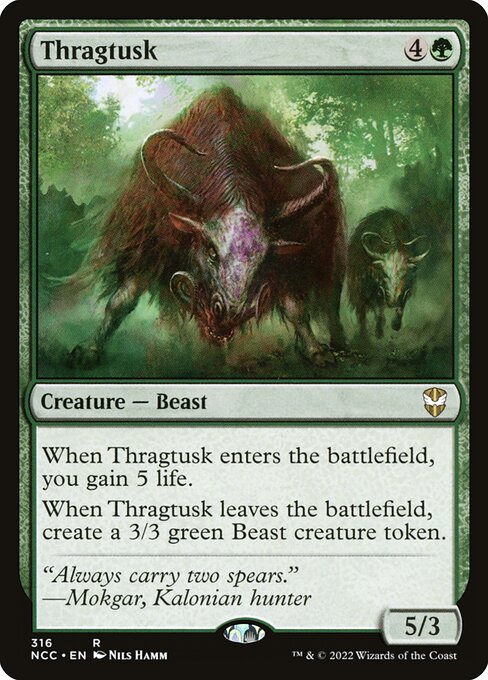
Midrange: strong cards and adaptability
Midrange combines threats with answers. Against a faster deck, you try to stay afloat first; against a slower deck, you want to apply pressure. You look for cards that are useful on their own and can fulfill multiple roles.
Thragtusk demonstrates this principle: upon entering, you gain five life, and when it leaves the battlefield, you get a 3/3 Beast. It can help stabilize while simultaneously being an attacker. Not every midrange card needs to be expensive; it’s about the function within your plan.
Fits you if: you enjoy reacting to the situation. The tricky part is recognizing when to stop defending and start trying to win yourself.

Control: choose which problems you solve
Control wants to build up enough time and resources to win the long game. Removal, board wipes, and card advantage help with this; blue can additionally counter spells. Counterspell hits a spell on the stack, not a permanent already on the battlefield, and not an activated or triggered ability.
In multiplayer, you cannot answer every card from three opponents one by one. Save answers for relevant threats and also ensure you have your own way to close out the game.
Fits you if: you like timing and weighing options. Control doesn't have to be blue, and a few counterspells don't make a deck a control deck on their own.
Tempo: hold your advantage long enough
A tempo deck usually combines an early threat with cheap interaction. You don't have to leave the opponent completely out of cards; a few extra attacks can be enough. Bouncing a creature to the hand, for example, can buy time, even if the opponent is allowed to cast it again later.
Delver of Secrets is a well-known example of an early threat in such decks: under the right conditions, it transforms into a 3/2 with flying. The game plan then calls for the right moment for protection or disruption.
Difference from control: tempo primarily defends an advantage that is already present. “Tempo” is also a general game concept: an aggro or midrange deck can also win or lose tempo.
Combo: let cards do the decisive work together
A combo deck revolves around a combination that produces much more than the sum of its individual parts. That can be a repeatable loop, but a combo doesn't have to be infinite. Some combinations win immediately; others first generate lots of mana, damage, or cards and require a follow-up step.
Fits you if: you enjoy order, recognizing possibilities, and protecting your plan. The difficulty varies significantly per combination. Not every combo is fast, and not every combo fits at the same Commander table.


Card example: how Thassa’s Oracle works with Demonic Consultation
This is an example of a powerful winning combination, intended to understand the mechanics. The usual sequence is:
- Cast Thassa's Oracle and let the creature spell resolve. Oracle enters the battlefield; its triggered ability goes on the stack.
- Cast Demonic Consultation while that trigger is still on the stack. Upon resolution, you name an existing Magic card that is not in your library.
- Consultation first exiles six cards and then searches further for the chosen name. If that card is not in your library, the rest will also be exiled.
- Then let the Oracle trigger resolve. You win if your blue devotion is at least equal to the number of cards in your library. With an empty library, even zero devotion is sufficient.
You do not cast Consultation in response to the creature spell if you want to follow this sequence. Opponents can respond to spells and triggers. Only removing Oracle after its trigger is on the stack does not stop the win if the library is empty. You can read more about that sequence in the stack and priority explained.
Eleven popular Commander themes and building strategies
Below, the focus is primarily on the cards and interactions used to build a deck. These directions can overlap: tokens with +1/+1 counters, landfall with ramp, or enchantments around a single attacker.

Voltron: one attacker, lots of support
Voltron strengthens one creature with, for example, Equipment, Auras, and protective cards. Often this is your commander, making commander damage a win condition. You want not only to become large but also to get through blockers and survive removal.
Rafiq of the Many gives a creature that attacks alone double strike; exalted also gives that attacker +1/+1. Rafiq can attack himself, but his abilities also work for another creature that attacks alone.
Note: a player loses at 21 or more combat damage from the same commander over the entire game. Damage from different commanders is not combined. Regular damage abilities and life loss do not count as commander damage.

Tokens / go-wide: build a wide board
A token deck creates extra permanents, often creature tokens, and utilizes their numbers. You can attack widely, strengthen your army, or use tokens as resources for other effects. “Go-wide” means many creatures alongside each other; they don't all have to be tokens.
Adrix and Nev, Twincasters doubles the tokens that are created under your control. This also works for, for example, Treasure or Clue tokens, not just creatures.
Fits you if: you like building a visible army. Keep track of different token types and their properties clearly. A board wipe can hit a lot, but card draw, protection, and ways to rebuild make a difference.

+1/+1 counters: let your creatures grow
This theme builds lasting enhancement via +1/+1 counters. That can result in one huge creature, but also make an entire team grow. It therefore combines perfectly with tokens.
Hardened Scales does not double counters. If one or more +1/+1 counters would be placed on a creature under your control, that number becomes one higher. Three counters in such an event thus become four.
Note: large power is not yet a guarantee of damage to players. Trample, flying, or another way to get past blockers might be necessary. Also distinguish between actual counters and a temporary +1/+1 bonus.

Aristocrats: make dying creatures pay off
Aristocrats combines creatures you don't mind losing, ways to sacrifice them, and cards that reward their death. This allows a small token to be both fuel for your own ability and a source of life loss simultaneously.
Blood Artist triggers when it or another creature dies: one target player loses one life and you gain one life. Zulaport Cutthroat works differently: upon the death of itself or another creature you control, each opponent loses one life and you gain one life.
Note: these cards do not allow creatures to sacrifice themselves; you need a separate way to do that. Tokens can cause death triggers. Exiling is not dying, which means exile-removal or graveyard interaction can disrupt your engine.

Spellslinger: get more out of instants and sorceries
Spellslinger decks pair many instants and sorceries with cards that reward casting them. This lets you draw cards, create tokens, buff creatures, or deal damage. Depending on the deck list, an aggressive, control, or combo plan fits well.
Guttersnipe deals two damage to each opponent when you cast an instant or sorcery. This does not apply to every type of spell. Copying a spell is usually not a cast, so a standard copy does not automatically trigger Guttersnipe again.
Fits you if: you enjoy planning sequences and mana. Keep track of your triggers and know in advance which cards you want to return or search for, so your turn keeps moving smoothly.

Ramp / big mana: build towards bigger plays
Ramp increases your available mana. In a big-mana plan, this acceleration is a core component: you want to deploy large creatures, powerful effects, or a massive X-spell sooner. Other decks use ramp too, without necessarily being a "ramp deck."
Cultivate searches for up to two basic lands: one goes tapped to the battlefield, the other to your hand. That card in your hand helps prepare for your next land drop; Cultivate does not give you two extra lands directly on the battlefield.
Note: you need both acceleration and something useful to do with it. Too many expensive cards can lead to a slow start; too much mana without draw or payoffs can leave you stuck later on.

Reanimator: use your graveyard as a resource
Reanimator puts creatures into the graveyard and returns them to the battlefield. This can help bypass a high mana cost, but can also allow a useful effect to be triggered repeatedly. Not every graveyard deck is focused exclusively on reanimation.
Reanimate can return a creature card from a graveyard to the battlefield under your control. You lose life equal to its mana value. Archon of Cruelty is an example of a target with a powerful ability both when it enters and when it attacks.
Note: graveyard interaction can remove your target. Quickly bringing back a large creature is a potential execution, not a guaranteed turn-two win. Also build a plan for games where your graveyard is not available.

Tribal / typal: build around a creature type
Elves, Goblins, Zombies, Dragons: a shared creature type can be the basis of your synergy. Supporting cards reward that type with, for example, extra power, mana, or cards. “Tribal,” “typal,” and “kindred” are all terms you will encounter in discussions about such decks.
Elvish Archdruid gives other Elf creatures you control +1/+1. His tap ability produces one green mana for each Elf you control, including himself if he is still an Elf.
Fits you if: you want a recognizable theme. The difficulty depends on the list: Elves can form a straightforward aggro deck, but also a complex combo engine. Besides synergy, don't forget card draw, removal, and a clear end goal.

Stax / prison: limit what players can do
This deck style uses permanent restrictions, extra costs, or effects that squeeze resources. You try to build a deck that functions better under those conditions than your opponents do. The terms "stax" and "prison" overlap, although players don't always use them exactly the same way.
Winter Orb lets players untap at most one land during their untap step, as long as Winter Orb itself is untapped. It does not automatically limit the untapping of all permanents.
Discuss it beforehand: such effects can drastically change the game. They are not necessarily slow; some lists combine restrictions with a fast win route. Make it clear how much resource denial you are playing and how you intend to finish the game.

Landfall: make lands do more than produce mana
Landfall abilities react to lands entering the battlefield under your control. This doesn't have to be your regular land play; a land you put onto the battlefield with a search spell can also trigger an effect.
With Omnath, Locus of Creation, the effects are separated. His own entry lets you draw a card. His landfall ability gives four life for the first resolution per turn, red, green, white, and blue mana for the second, and four damage to each opponent and each planeswalker you don't control for the third.
The fourth and subsequent resolutions that turn provide nothing extra via this ability. You do not get all mentioned benefits for every land. Note: keep track of triggers and mana and choose a concrete win route for the resources you've built up.

Enchantress: build an engine with enchantments
Enchantress decks use enchantments alongside cards that benefit from them, often by drawing extra cards. The ultimate win route can be wide attacks, a single buffed creature, or a combo.
Sythis, Harvest's Hand gives one life and one card whenever you cast an enchantment spell. Putting an enchantment directly onto the battlefield is not a cast and does not activate this ability. The cast trigger can still happen if the enchantment spell is countered afterward.
Fits you if: you like building a cooperative board. Watch out for mass enchantment removal and ensure your engine eventually does more than just draw new cards.
And even more themes
Magic has many more possibilities. Blink/flicker reuses entry effects; superfriends revolves around planeswalkers; artifacts centers on artifact synergy. Group hug gives players extra resources and requires its own end plan. Mill shrinks libraries: an empty library alone doesn't usually mean loss, but having to draw a card when you can't does.
Which archetype fits you?
Choose based on what you enjoy doing during a game. These are starting points to try, not a ranking of easy versus hard decks.
| You enjoy | Then take a look at | Check before choosing |
|---|---|---|
| Attacking and building a visible board | Aggro, tokens, or a creature type. | How do you recover after removal or a board wipe? |
| Focusing on one favorite creature | Voltron. | How do you protect it and get past blockers? |
| Alternating between attack and defense | Midrange. | Can you recognize when your role changes? |
| Timing and understanding opponents | Control or tempo. | Can you distinguish major threats from distractions? |
| Many synergistic effects | Aristocrats, spellslinger, landfall, or enchantress. | How many triggers and actions do you have to track per turn? |
| Executing a precise combination | Combo. | Do you understand the sequence, potential reactions, and table etiquette? |
Want to build yourself? Continue with building your first Commander deck. Looking for a ready-to-play start, check out our Commander precons for beginners.
An archetype doesn't automatically dictate how strong your deck is
A token deck can build up slowly or win extremely fast. A combo can require several turns of preparation or be ready very early. Labels like “casual,” “tribal,” or “control” therefore don't tell enough about the expected gameplay experience.
Before a Commander game, discuss your speed, win routes, strong tutors, combos, and effects that restrict others for long periods. That conversation is useful for every archetype. Normal interaction, such as a removal spell or counterspell, is part of the game; a completely restrictive plan requires different expectations.
The official Commander Brackets and Game Changers list can help with this. For control, Thassa’s Oracle is on that list. However, a deck is not judged solely on one card or the number of Game Changers: the entire strategy and intended gameplay count. Also read the unwritten rules of the table.
Frequently asked questions about MTG deck archetypes
Which archetype is best for beginners?
A concrete plan with clear interactions is often a pleasant start, such as creating creatures and attacking. This can be done with tokens, a creature type, or large creatures. But even within those themes, there are complex lists. Look at the actual cards and the number of choices, not just the name of the archetype.
Can a deck combine multiple archetypes?
Yes. A deck can, for example, play aggressively with tokens or support a control plan with enchantments. Just make sure the components help each other. A clear main plan makes building and playing more manageable.
Are aggro and tokens the same?
No. Aggro describes a plan with early pressure. Tokens describes a way to create permanents. A token deck can be aggressive, slowly accumulate value, or use tokens for sacrifices and combos.
Does every archetype have fixed colors?
No. Certain effects appear more often in some colors, but a single card example does not set a color rule for the entire archetype. In Commander, the color identity of your commander determines which cards you can include in your deck.
What is the difference between an archetype and a Draft theme?
In Draft, “archetype” is often used for a supported color combination within a specific set, for example, blue-red spells or green-white counters. Which combinations and rewards exist depends on that set. Such a deck can subsequently also be aggressive or geared toward the long game.
Sources and card information
The explanation has been checked against Wizards’ strategy guides, the rules of the game, and current Oracle card texts. The guidance provided is editorial advice; there is no official score for the difficulty or playability of an entire archetype.
- Reid Duke, Wizards of the Coast: Aggro Decks, Midrange Decks, Control Decks, and Tempo. These articles underpin the general strategy concepts; the historical deck lists are not current meta recommendations.
- Wizards — Theros Beyond Death Release Notes: including the functionality of Thassa’s Oracle at zero devotion and an empty library.
- Wizards — Comprehensive Rules: commander damage, casting, copies, triggers, and conditions for losing a game.
- Wizards — Commander and current Brackets and the official ban lists.
- The linked card names open Scryfall with Oracle text and printings. Gatherer is the official card database.
Card images: Wizards of the Coast. Existing images are displayed via SpellArmory; additional examples via Scryfall. Click on a card to view a larger image. A displayed printing is not a recommendation for a specific version.

Written by Omèr Cremers
Owner of SpellArmory, social worker, and full-time father. A fanatical MTG player and collector from Maastricht — Commander is my favorite format. Questions about which product suits you best? Feel free to send me a message.