

Commander in a nutshell
- You usually play with four players, each with their own deck and 40 life points.
- Your deck consists of exactly 100 cards, including your commander. Normally, that is one commander plus 99 other cards.
- Except for basic lands and explicit card exceptions, each card name may appear only once.
- Your commander determines the color identity of your deck and starts separately in the command zone.
- My advice for a first Commander deck: start with a precon and a table that is happy to help you.
Four players, four different decks, and a table where something is always happening: that is Commander. It is my favorite Magic format, precisely because you can build a deck entirely around a card, theme, or playstyle.
Here you will learn the basic rules and what you need for your first game. Not familiar with Magic itself yet? Start by learning how Magic: The Gathering works. Commander adds its own rules to the regular game; it does not replace those basics.
What is Commander and what does EDH mean?
Commander is a Magic format in which you build a deck around a commander. EDH stands for Elder Dragon Highlander, the original name. Players use both names for the same format.
Usually, you play with four people in a pod: you each play for yourselves, not automatically in teams. You can attack different opponents and make temporary agreements. That makes not only your cards important, but also the conversation at the table.
The large card selection and the singleton principle ensure a lot of variety. However, with four decks simultaneously, many abilities and interactions can arise. My advice: learn with patient fellow players and decks that match each other. A calm one-on-one practice game can be a more pleasant first introduction to Magic.
The most important Commander rules
| Component | How it works |
|---|---|
| Deck size | Exactly 100 cards, including your commander or legal commander duo. |
| Singleton | Maximum one copy per card name. Basic lands and cards that allow an exception themselves are allowed more often. |
| Starting life | Each player begins with 40 life points. |
| Color identity | All cards must fit within the color identity of your commander. |
| Command zone | Your commander starts face-up next to your deck. You may cast them from that zone, according to normal timing rules. |
| Commander damage | 21 or more combat damage from the same commander to the same player means that player loses. |
Tokens, ad cards, and extra display cards do not count as part of your deck. Lands do count toward the 100 cards. Different illustrations or languages do not make the same card a different card name.
Choosing your commander: which cards are allowed?
You usually choose a legendary creature. Under current rules, legendary Vehicles and legendary Spacecraft with a power/toughness box are also allowed. In addition, there are cards that explicitly state they can be your commander, such as certain planeswalkers. Not every legendary card is automatically a valid commander.
Some abilities allow two commanders, for example, a valid Partner combination. In that case, you have two commanders plus 98 other cards, and you combine their color identities. You cannot simply pick two random legendary creatures.
Color identity is more than the color in the top right
For color identity, you look at, among other things, the colored mana symbols in the mana cost and the rules text. Color indicators and relevant text on the back of double-faced cards can also count. Explanatory text in parentheses, known as reminder text, does not count.
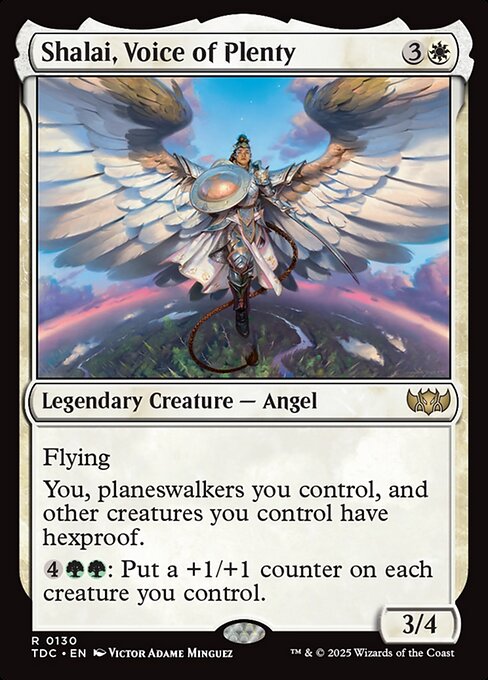
Shalai costs three mana of your choice and one white mana. But at the bottom of her text is an ability with two green mana symbols.
If Shalai is your commander, you may therefore use cards with a white, green, white-green, or colorless color identity. You do not have to have both colors on every card.
Blue, black, and red fall outside her color identity. Your lands must also comply with the deck-building rules: a Forest or Plains fits, an Island does not.
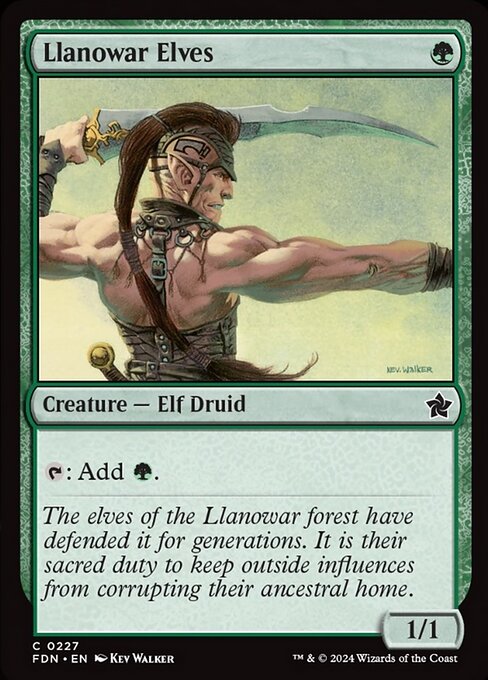
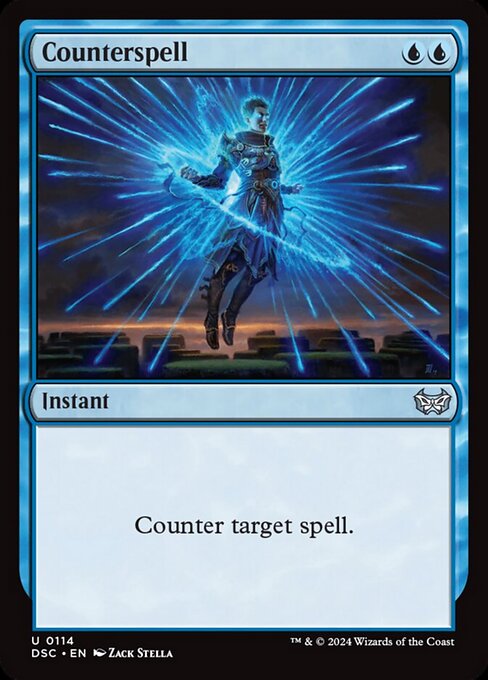
These are examples of deck legality, not mandatory card choices. Card images via Scryfall; cards and illustrations © Wizards of the Coast and the respective illustrators.
SpellArmory Tip
Unsure about a hybrid mana symbol, such as green/white? For color identity, both colors count. The fact that you can pay for the card with only one of those colors does not change the deck-building rule. When in doubt, check the color identity and the current rules text of the card.
The command zone and commander tax
You do not shuffle your commander into your deck. They start face-up in the command zone, a separate game zone. From there, you can cast them whenever you would normally be allowed to cast them. For example, a creature without flash is usually cast during your own main phase, when the stack is empty.
Your commander is not on the battlefield while in that zone. Their abilities only work from the command zone if a rule or the ability allows it.
Every previous cast from the command zone counts
Commander tax is two extra generic mana for every time you have previously cast that commander from the command zone. Generic means you can pay those extra costs with any type of mana.
| Cast from command zone | Total cost |
|---|---|
| First time | 3 generic + 1 white = 4 mana |
| Second time | 5 generic + 1 white = 6 mana |
| Third time | 7 generic + 1 white = 8 mana |
Count casts, not the number of times your commander dies. A countered cast from the command zone also counts. If you cast them from your hand, you do not pay commander tax; previous casts from the command zone are not cleared by this.
What happens when your commander leaves?
- To the graveyard or exile: your commander actually goes to that zone first. During the next check of state-based actions, you may move them to the command zone.
- To your hand or library: you may choose to have them go to the command zone instead.
Returning is therefore a choice of the owner, not an obligation. You can, for example, leave them in your graveyard for a card that retrieves them. That choice does not give you the right to move them to the command zone at any other time later.
Commander damage: only combat damage counts
In addition to your life points, you keep separate track of how much combat damage each commander has dealt to you. If you receive 21 or more from one and the same commander, you lose, even if you still have plenty of life points.
A simple calculation example
7 + 7 + 7 combat damage from the same commander = 21.
This can be spread over multiple turns. Conversely, if you receive 12 from commander A and 9 from commander B, both trackers have not yet reached 21.
- Damage from an ability does not count as commander damage, even if your commander causes that damage.
- Gaining life does not lower this tracker. Commander damage is otherwise normal damage that also lowers your life points.
- The tracker remains if that commander changes zones or controller. Keep track of damage per commander and per affected player separately.
How to start your first Commander game
- Sync with the table. Mention that you are starting, which deck you have, and whether it has been modified. Discuss together what kind of game you all want.
- Prepare your play area. Place your commander face-up in the command zone, shuffle the other cards, and set tokens and counters aside.
- Determine who goes first. Set everyone to 40 life points and draw seven cards. Turns proceed clockwise.
- Assess your hand. You may take a new starting hand: a mulligan. In multiplayer, the first mulligan is free.
- Start playing. In a regular free-for-all with three or more players, the starting player also draws a card in their first draw step.
How does that free mulligan work?
You shuffle your entire hand back and draw seven cards again. On your first mulligan in multiplayer, you do not have to put a card on the bottom. On your second, you draw seven again and put one card on the bottom of your library; on your third, that becomes two cards.
You do not pick a few bad cards to replace only those. This is the standard mulligan procedure with the multiplayer exception.
SpellArmory Tip
For your first few games, look for a hand you can actually start with: lands that provide the right colors and a few cards you can play early. Only big, impressive creatures without enough mana is usually not a pleasant start. Feel free to ask if someone wants to help you evaluate your first hand.
The turn structure remains standard Magic: untap, upkeep, draw a card, main phase, combat, a second main phase, and the end step. You may divide your attackers among multiple opponents; you designate who or what each creature is attacking. If you want to understand when you can respond to a spell, read the explanation about the stack and priority.
Starting with a precon: what do you need?
A preconstructed Commander deck, or precon for short, is a pre-assembled 100-card deck, including commander and lands. You do not need to buy boosters to complete the deck. Extras such as tokens and a deck box vary per product.
My advice: choose a theme whose plan you can explain, for example, buffing creatures or creating tokens. Do not look only at the coolest commander, but also at how many different triggers and choices the deck requires. A precon is a practical starting point, not automatically the cheapest, simplest, or strongest deck.
For a first evening, I would have this ready:
- Your complete deck, preferably protected with suitable sleeves.
- A way to track life and commander damage separately, for example, paper or a suitable app.
- The necessary tokens and counters for your own cards.
- Sufficient time and fellow players who know you are still learning.
Need help choosing? View Commander precons for beginners or go directly to the Commander decks in the shop.
Rule 0 and brackets: choose a suitable table
By Rule 0, players mean the conversation and agreements before the game. Do not just say “my deck is casual,” but explain what it does, how fast it can win, and whether it contains prominent combos or restrictive cards.
How to start the conversation
“This is my first Commander deck. It is an unmodified precon and I do not know all the cards yet. Do you have decks that match this, and can we explain things slowly for the first few turns?”
Wizards’ Commander Brackets are an optional tool for that conversation. It is about the desired play experience, not an exact grade for your deck.

Written by Omèr Cremers
Owner of SpellArmory, social worker, and full-time dad. Fanatical MTG player and collector from Maastricht — Commander is my favorite format. Questions about which product suits you? Feel free to send me a message.