

You learn Magic by doing a few simple things over and over again: drawing a card, playing a land, using mana, and deciding whether to attack. This guide helps you go from your first card to your first game.
- We start with a duel between two players, each with 20 life.
- You will learn to read cards, pay your mana, play a turn, and attack or block.
- Real card examples and short practice situations show how the rules come together.
Your first Magic card can be quite overwhelming. English text, tiny symbols, all sorts of numbers: where do you start? Luckily, you don't need to know thousands of cards to play. You first learn the basics and then read what your cards add to them.
In this beginner's guide, I explain it step-by-step, using the same cards that might be on the table. Feel free to grab a card yourself. The extra explanation in expandable blocks can be saved for your second game.
1. What is Magic: The Gathering?
Magic: The Gathering, usually shortened to Magic or MTG, is a trading card game. You use your own stack of cards, your deck, to summon creatures and cast spells. With those cards, you try to defeat your opponent.
In our first duel, everyone starts with 20 life. A common path to victory is bringing the opponent to 0 life. You can have more than 20 life; 20 is the starting point here, not a maximum.
What you need
- Two decks suitable for playing against each other.
- A way to keep track of life, for example, paper, counters, or an app.
- A clear table and optionally markers for tokens and counters.
For many ways of playing with pre-built decks, at least 60 cards is the standard. However, a learning product might use its own setup: follow the included tutorial for a Beginner Box. Jumpstart and the combined theme decks from the Foundations Beginner Box usually use 40 cards. Commander works differently, with 100 cards including commander(s) and 40 starting life.
SpellArmory Tip
Learn the basics first with two simple decks. Say your moves out loud: “I draw, play a land, and cast this creature.” That way, the other person can help, and you’ll hear the rhythm of the game.
The rules below describe the normal situation. A card can be an exception to this, for example, by letting you play an extra land.
2. Lands, mana, and tapping: the engine of your deck
A land is a card; mana is what that card can produce. With mana, you pay the costs of spells and some abilities. For example, a Mountain can produce one red mana.

Mountain: play the land, use the mana
Playing a Mountain costs no mana. During your own main phase, you are normally allowed to put one from your hand onto the battlefield, provided the stack is empty and you have priority. We will get acquainted with that timing shortly.
You can then tap an untapped Mountain for one red mana. This is also allowed on the turn you played it. The red symbol on this basic land refers to its mana ability: it is not a cost you have to pay.
What does tapping mean?
Tapping means turning a card 90 degrees. This shows that you have used the card for something that requires tapping. You cannot tap a card that is already tapped to pay the same type of cost. Untapping means turning it back to its upright position.
Ready to be used for mana
Produces one red mana when tapped
Your lands stay on the table after you have used their mana. At the start of your next own turn, you normally untap your tapped permanents. You can then use those lands again. You don't need to discard land cards for every spell.
How do you pay a mana cost?
Shivan Dragon costs 
 . You pay six mana in total: two of them must be red. For the remaining four, you can use mana of any color, or colorless mana. Six Mountains can pay for it, but two Mountains and four Forests also work.
The number represents a generic cost: four mana of any type. That is different from the symbol  , which specifically asks for colorless mana. Colorless is not a sixth color.
Three things to remember
- Normally you play one land per own turn, not one per spell.
- You may cast multiple spells in one turn if you can pay the costs and the timing is correct.
- Unused mana normally disappears at the end of each step and phase. So you don't save mana for the next turn.
3. How to read a Magic card
Here is Shivan Dragon. This classic dragon demonstrates the most important parts well. The numbers next to the card correspond to the explanation. Click or tap on a card image for a larger view and card details.
 12345
12345
- Name. This is how you identify the card. Different illustrations or languages can still represent the same card.
- Mana cost. In the top right is what you normally pay to cast the spell: here, four mana of your choice plus two red. The total value is called mana value: here, 6.
- Type line. Here it says Creature — Dragon. Creature is the card type, Dragon is the subtype.
- Rules text. Shivan Dragon has flying. Additionally, you can pay one red mana to give it +1/+0 until end of turn. You activate that ability separately; you do not get that bonus automatically when casting it.
- Power and toughness. The dragon is 5/5. Power is the amount of combat damage it normally deals. Toughness determines how much marked damage is lethal: normally, a creature dies as soon as that damage is at least its toughness.
A 5/5 with 2 damage on it is still a 5/5, not a 5/3. The damage stays for that turn, though. Three additional damage can still kill the dragon.
What do the set symbol, the fine print, and the card color mean?
The symbol next to the type line refers to the set. For many cards, the color also indicates the rarity: black for common, silver for uncommon, gold for rare, and orange-red for mythic rare. There are variant and older versions.
At the bottom, you will find, among other things, the collector number and the illustrator. Italicized text in parentheses is often rule explanation; flavor text tells a bit of a story and does nothing in the game.
The color of a card usually follows from the colored symbols in the mana cost, not exclusively from the frame or illustration. Shivan Dragon is red. A Mountain produces red mana but is itself normally a colorless card.
4. The five colors of Magic
Every color has its own strengths. Think of this as a first impression, not a hard boundary: cards and combinations can do more than what is stated in this overview.
 White · WPlains
Cooperation, many creatures, and protection.
 Blue · UIsland
Drawing cards, reacting, and countering spells.
 Black · BSwamp
Eliminating creatures, sacrificing, and using the graveyard.
Red · RMountainAttacking quickly and dealing direct damage.
 Green · GForest
Developing extra mana and playing large creatures.
Below every color is its associated basic land. Feel free to start with one or two colors; that makes it easier to produce the right mana. No single color is "the best" on its own.
5. Which card types will you encounter?
A card that stays on the battlefield is called a permanent. A creature card in your hand is therefore not yet a permanent. Instants and sorceries normally do their work and then go to the graveyard.
By casting a spell, we mean playing a non-land card as a spell, including paying the costs. Playing a land is not casting a spell. Therefore, it also does not make use of the stack, the pile where spells wait to resolve.
| Card type | What does it do? | Normal timing |
|---|---|---|
| Land | Often provides mana; stays on the battlefield. | Own main phase, with priority and an empty stack; normally one per turn. |
| Creature | Can attack and block; stays on the battlefield. | Own main phase, with priority and an empty stack. |
| Sorcery | An effect, e.g., drawing cards; then to the graveyard. | Own main phase, with priority and an empty stack. |
| Instant | An effect that is also possible as a reaction. | When you have priority, also during the opponent's turn. |
| Enchantment | Lasting spell; an Aura attaches itself to something. | Own main phase, with priority and an empty stack. |
| Artifact | Lasting object, e.g., a mana source or Equipment. | Own main phase, with priority and an empty stack. |
| Planeswalker | Permanent with loyalty and own abilities; can be attacked. | Own main phase, with priority and an empty stack. |
Priority means it is your turn to use a spell or ability. An empty stack means there are no spells or abilities waiting to resolve. Under reacting with instants, you will see how that works. Card text like flash can change the normal timing.

Creature: Grizzly Bears
Grizzly Bears costs  and is 2/2. You pay two mana, at least one of which must be green. After the creature spell has resolved, the card is on the battlefield.
These Bears have no extra abilities. Because of that, you can focus fully on the two numbers: they normally deal 2 combat damage and normally die upon receiving 2 or more marked damage.
A new creature can usually block
Normally, a creature can only attack, or use an ability with the tap or untap symbol in its cost, if you have continuously controlled it since the beginning of your most recent turn. That is called summoning sickness. It does not limit blocking. Haste lets the creature ignore this restriction.

Sorcery: Divination
Divination costs  and lets you draw two cards. After that, the spell goes to your graveyard. You normally cast it in one of your own main phases, with priority and an empty stack.
So, you don't use this sorcery in response to an attack during the opponent's turn.

Enchantment: Pacifism
Pacifism is an Aura. You cast it for , choosing a creature as a target. Once it resolves, Pacifism remains attached to that creature.
The creature then cannot attack or block. It remains on the battlefield and keeps its other abilities. Pacifism therefore does not destroy the creature.
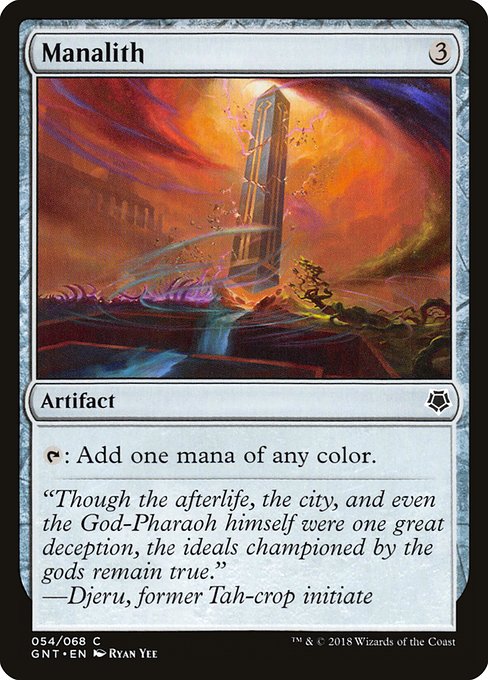
Artifact: Manalith
Manalith costs  and remains on the battlefield. You can tap it for one mana of any color. This shows you that cards other than lands can produce mana.
Manalith is not a creature and can normally use its tap ability immediately. Artifacts are not always colorless, and whether a card is allowed in a deck also depends on the format.
We will look at Instants later with Lightning Bolt and Giant Growth. Cards can also have multiple types, such as Artifact Creature. Furthermore, there are things like battles and cards with kindred; you do not need to master those for your first simple duel.
Additional explanation: how does a planeswalker work?

Ajani, Caller of the Pride
Ajani starts with four loyalty counters. His +1 adds one loyalty and can place a +1/+1 counter on a creature. That counter normally stays; it is not a bonus that disappears at the end of the turn.
His −3 costs three loyalty and gives a creature flying and double strike until the end of the turn. Adding or removing loyalty is part of the ability's cost.
You can normally activate one loyalty ability per planeswalker per turn, during your own main phase with priority and an empty stack. You can also do this on the turn the planeswalker enters the battlefield. For a minus ability, you must have enough loyalty to remove.
An opponent can attack a planeswalker. You can block those attackers with your creatures. Damage to the planeswalker normally removes an equal amount of loyalty; at 0 loyalty, it goes to the graveyard. A planeswalker is not a creature by itself and cannot block.
6. Prepare your play area and choose your starting hand
You do not need a special playmat. A fixed layout helps to see what is where. This diagram shows your side of the table:
The battlefield is one shared zone, although everyone keeps their own cards on their side. Your graveyard and exile are different zones. A card in exile is not literally outside the game. You use the stack for spells and abilities that are waiting; you don't need a separate playmat for that.
How to start a normal duel
- Randomly determine who gets to choose to go first or second.
- Shuffle your decks and set life totals to 20.
- Each player draws seven cards.
- Evaluate your hand and take a mulligan if necessary.
- Start the game. In a two-player duel, the starting player skips their first draw step.
Are you using the prescribed tutorial from a Beginner Box? Follow that setup, including the fixed card order. Do not shuffle the tutorial decks until the manual tells you to.
What is a mulligan?
A mulligan gives you a new starting hand. Shuffle your hand back into your deck and draw seven cards again. Once you decide to keep that hand, put a number of cards of your choice on the bottom of your library: one for each mulligan you have taken.
In this normal duel, you keep six cards after one mulligan; after two mulligans, five. With every attempt, you draw seven again first. In multiplayer Commander, the first mulligan is free; we do not use that exception here.
For a simple 60-card deck, a hand with two to four suitable lands and a few affordable spells is often a good starting point. Look at the colors too: three Forests won't help you if all your early spells require red mana.
7. A turn from start to finish
Magic has five phases per turn. Important: you have two main phases, but normally still only one land per turn.
-
Beginning phase · untap, upkeep, draw
Untap your permanents. After that, any upkeep effects occur. Then you draw one card, except during the starting player's skipped first draw step.
-
First main phase
You can play your land and cast spells. You cast creature, artifact, and other common permanent spells and sorceries here if you have priority and the stack is empty.
-
Combat phase
After the beginning of combat, you choose attackers, the defender chooses blockers, and combat damage follows. Afterward, combat ends. You may also choose not to attack.
-
Second main phase
You can cast spells again. If you haven't played a land yet, you can do so here. You do not get an extra land turn, and your lands do not untap by themselves.
-
Ending phase · end step and cleanup
In the end step, you resolve end-of-turn triggers and can still react. In the cleanup step, discard down to your maximum hand size if necessary, normally seven. Marked damage disappears and "until end of turn" effects end.
You may have more than seven cards in your hand in between. Only during the cleanup of your own turn do you normally have to go back to seven. Afterward, it is the other player's turn; your cards do not untap automatically then.
A simple start with Grizzly Bears
Your first turn: play a Forest. You don't necessarily have to do anything else.
Your second turn: untap, upkeep, draw a card, and play a second Forest. Tap both Forests to cast Grizzly Bears for . The Bears cannot attack this turn.
On the opponent's turn: if the Bears are untapped, they can block. If they survive until your next turn, they can normally attack as well.
8. Attacking and blocking explained
Creatures are often your most important way to deal damage. An attack consists of choices by both players:
- The attacker chooses attackers. Choose all attacking creatures at the same time. They must normally be untapped and cannot have summoning sickness. Attacking taps them, unless they have vigilance, for example.
- The defender chooses blockers. Only untapped creatures can normally block. Blocking does not tap them. One creature normally blocks one attacker; multiple creatures may block the same attacker together.
- The creatures deal damage. Without first strike or double strike, this happens simultaneously. Each creature deals damage equal to its power.
You attack an opponent or their planeswalker, not a creature directly. The defender chooses which creatures will intercept your attack. Battles also have attack rules, but we'll save those for later.
An unblocked attacker damages what it attacks. A blocked attacker normally damages the blocker(s), not the player. If a creature has lethal damage, it normally goes to the graveyard.
Example: Colossal Dreadmaw versus Grizzly Bears
You attack a player with an undamaged Colossal Dreadmaw (6/6, trample). The opponent blocks with undamaged Grizzly Bears (2/2). There are no other effects.

Thanks to trample, after assigning lethal damage to all blockers, you may assign the rest to the attacked player. You choose this distribution here:
The Bears die. The opponent loses 4 life. Dreadmaw survives as a 6/6 with 2 damage on it; that damage disappears during cleanup. Dreadmaw dealt a total of 6 damage, not 6 to the Bears plus another 4 to the player.
Without trample, a blocked 6/6 would assign all 6 damage to this blocker and no damage to the player. A small blocker can therefore intercept a large attack, even if it doesn't survive itself.
What if there are multiple blockers, or a blocker disappears?
If multiple creatures block one attacker, the attacker divides its damage among those blockers. You don't have to set an order for this beforehand. For trample, you must first assign lethal damage to all blockers before the rest can go to the attacked player.
An attacker remains blocked if its blocker disappears after blocking. Without trample, it then normally deals no combat damage to the player. With trample, if there are no blockers left, it can assign its damage to the attacked player.
You can still use spells and abilities after assigning blockers but before combat damage is dealt. Between assigning damage and actually dealing it, there is no moment to react.
9. Instants and the stack: how to react
You can also cast an instant during your opponent's turn, when you have priority. Not literally at any moment: for example, you do not interrupt the resolution of another spell. During the untap step, no one has priority, and during a normal cleanup step, usually not either.
A cast spell goes on the stack. Players get an opportunity to react. When everyone passes in succession, the top spell or ability resolves. After that, players can do something again. Remember above all: the last reaction resolves first.

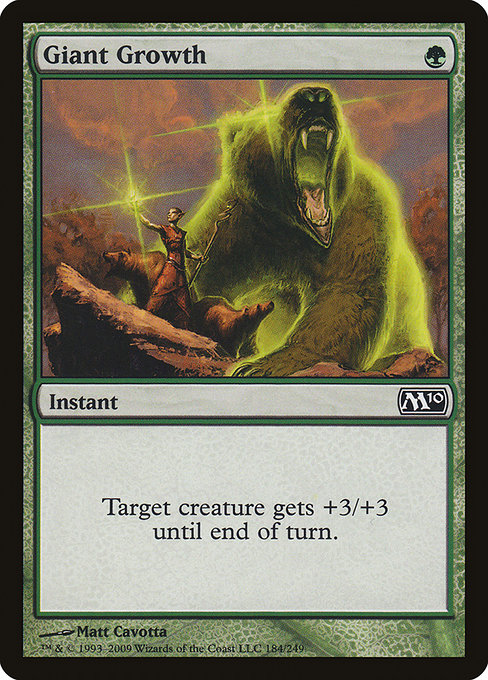
Lightning Bolt and Giant Growth
Your opponent casts Lightning Bolt and chooses your Grizzly Bears as the target. Bolt wants to deal 3 damage to your 2/2. You have an untapped Forest and Giant Growth in your hand.
- You get an opportunity to react and cast Giant Growth on the Bears. You pay one green mana for this.
- If no one else reacts, Giant Growth resolves first. The Bears become 5/5 until the end of the turn.
- Afterward, Lightning Bolt resolves and deals 3 damage to the Bears.
- The Bears survive as 5/5 with 3 damage on them. During cleanup, the temporary bonus and the marked damage disappear simultaneously: they are 2/2 again.
Resolves first: the Bears get +3/+3.
Resolves afterward: 3 damage to the chosen target.
If you wait until Bolt has already resolved and the Bears have died, then you are too late to save them with Giant Growth.
And what does Counterspell do?

Stopping a spell before it resolves
Counterspell costs and counters one chosen spell on the stack. If successful, that spell does not resolve and the card normally goes to the graveyard. The caster does not get the costs already paid back.
A permanent that is already on the battlefield is no longer a spell at that moment. So you cannot remove it with Counterspell. You also cannot counter playing a land with it.
Are abilities the same as spells?
An activated ability is usually recognized by "cost: effect", such as the red mana and the bonus of Shivan Dragon. A triggered ability often begins with "when", "whenever", or "at" and triggers when the described event occurs. A static ability works as long as the text applies, such as the restriction of Pacifism.
Many activated abilities and triggers use the stack, but they are not spells. Counterspell therefore cannot counter them. A common mana ability, such as tapping a Mountain for red, does not use the stack.
Do you want more examples? Read the full explanation of the stack and priority.
10. The keywords you need first
Keywords are short names for fixed rules. You don't have to memorize them all. Read the reminder text on the card if present, or look up the explanation.
| Keyword | What does it mean at the table? |
|---|---|
| Flying | Can only be blocked by creatures with flying or reach. A flying creature may itself block a non-flying attacker. |
| Reach | Can block creatures with flying. Doesn’t make your own attacker harder to block. |
| Vigilance | Doesn’t tap when attacking. This allows it to remain available to block later. |
| Haste | Ignores summoning sickness: may attack and use its own abilities with the tap or untap symbol immediately. |
| Trample | Can carry over excess combat damage to what it’s attacking, after all blockers have been assigned lethal damage. |
| Lifelink | Damage dealt by this source also causes you to gain that much life. This also applies to damage dealt to creatures, for example while blocking. |
| Deathtouch | Any positive amount of damage from this source to a creature is normally lethal. It does not bypass indestructible. |
| First strike | Deals combat damage in an earlier combat damage step. A blocker that dies from this does not deal its own normal combat damage afterward. |


Serra Angel demonstrates flying and vigilance: attacking without tapping, and being harder to block. Vampire Nighthawk combines flying, deathtouch, and lifelink. If it actually deals 2 damage, you gain 2 life; attacking without dealing damage does not result in life gain.
First strike in a simple combat
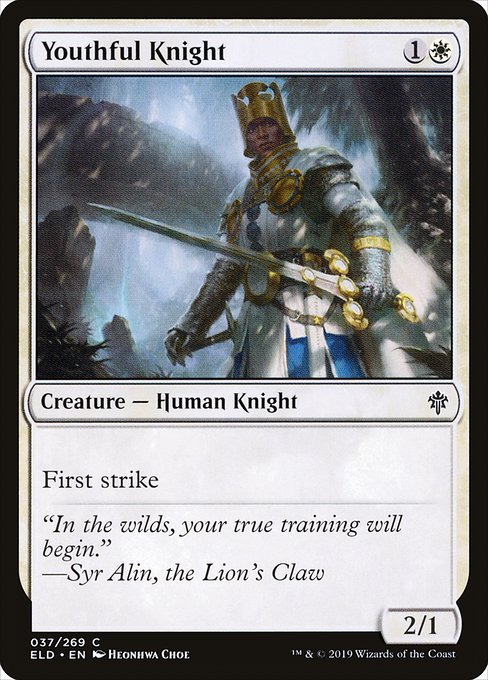
Youthful Knight versus Grizzly Bears
Youthful Knight is a 2/1 with first strike. If it is blocked by an undamaged 2/2 Grizzly Bears, the Knight deals 2 damage first. The Bears die before they can deal normal combat damage. The Knight survives.
If you remove first strike from the same example, a 2/1 and a 2/2 deal 2 damage simultaneously and both die. With double strike, a creature can deal damage in both the first and the normal combat damage step.
Hexproof, indestructible, and protection are not complete invulnerability
Hexproof prevents opponents from targeting that permanent with their spells and abilities. An effect that doesn't target can still work.
Indestructible prevents destruction, including from lethal damage. Exile or sacrifice effects work just as well.
Protection protects against certain damage, enchantments, or equipment, as well as blocking and targeting by the specified characteristic. It does not stop every effect. For example, a white spell that destroys all creatures without targeting can still destroy a creature with protection from white.
11. Three situations to try out yourself
Take a moment for the answer before expanding it. In these examples, there are no other cards or effects that change the situation.
You are playing Grizzly Bears. Are they allowed to block during your opponent's next turn?
Yes, if they are untapped. Summoning sickness normally prevents attacking and using abilities with the tap or untap symbol. Blocking is allowed immediately.
You attack with a 3/3 with no abilities. A 2/2 blocks. Does the player lose 1 life?
No. The 3/3 deals 3 damage to the blocker and takes 2 damage in return. The 2/2 dies, and the 3/3 survives. Without trample, no excess damage carries over to the player.
You played a land before combat. May you play a second one after combat?
Normally no. The limit applies to the entire turn, not per main phase. If you had not yet played a land before combat, you would have been allowed to do so after combat.
12. How a game of Magic ends
Usually, someone wins because the opponent reaches 0 or less life. There are also other ways to lose: being forced to draw from an empty library, or having ten or more poison counters. An empty library itself is not a loss; the failed draw action is what determines it.
Some cards provide their own win or loss condition. You may also give up, known as conceding. If both players lose at the same time, the game can end in a draw.
Keep this cheat sheet next to your deck
- Your turn: untap, upkeep, draw; main phase; combat; main phase; end step and cleanup.
- Lands: normally play one per turn on your turn. They remain on the battlefield after you use their mana.
- New creatures: usually cannot attack yet, but can block if they are untapped.
- Combat: you choose attackers, the other player chooses blockers. Damage is normally simultaneous.
- Responding: instants if you have priority. The last response resolves first.
- Cleanup: discard down to your hand limit, remove damage, and let temporary turn bonuses end.
13. What do you use for your first games?
My advice: choose one clear starting route. You don't need an expensive collector card or a large stack of random boosters to learn the basics.

Foundations Beginner Box
Guided learning
Two tutorial decks and instructions help you play your first game. Afterward, you can combine the theme decks. Includes playmats and life counters.

Bloomburrow Starter Kit
Play together immediately
Two pre-built 60-card decks. A suitable route if you prefer to practice with complete decks rather than building your own immediately.

Foundations Starter Collection
Learn to build decks yourself
A fixed collection of over 350 cards, basic lands, and additional boosters. Intended for deck building; no ready-to-play starter decks included.
Note on the Foundations Beginner Box: the Cats and Vampires tutorial decks are intentionally in a fixed order. Do not shuffle them before that first guided lesson. Later, you can combine two theme packs into a 40-card deck.
The Starter Collection has a different goal: learning to build. It also contains some extra Commander cards, such as Sol Ring, which are not automatically allowed in Standard. The cards in this guide are lesson examples, not a complete deck list or a guarantee that everything fits in the same tournament format.
Practice for free with MTG Arena
MTG Arena features a tutorial and allows you to practice digitally. The program handles many of the rules so you can focus on your choices. Start with the instructions and the initial options; you don't need to buy boosters for that.
Your digital collection is separate from your paper cards. A physical purchase does not automatically grant you the same cards in Arena, although some products contain a specific redemption code. Arena is handy for practice; at the table, you also learn to track damage, triggers, and phases yourself.
Want to build a simple deck yourself?
For your first standard 60-card deck, use about 24 lands as a starting point, with one or two colors. Fill it out with enough affordable creatures and a few clear spells. This is a learning recommendation, not a fixed deck-building rule: faster and slower decks may require different numbers.
In many Constructed formats, you may use a maximum of four copies with the same English card name, counted across your deck and any sideboard combined. Basic lands and explicit card exceptions work differently. Commander and Limited have their own rules. When attending an event, also check which sets and cards are allowed there.
Heading straight to Commander or a playgroup?
If your friends already play Commander, you can get started with a suitable precon and some guidance. There are, however, more cards and interactions on the table at once. For that, read Commander explained and check out Commander precons for beginners.
Are you from the area? At MTG playing in Maastricht and Limburg, you can find starting points for finding other players. Bring sleeves for your deck; our guide on protecting and storing cards will help you with your choice.
Watch the basics in a video
Want to see how this moves at the table? This English-language explanation is presented by The Command Zone on the official Magic channel. You can keep the examples above alongside it.
Watch the video directly on YouTube.
Your next step at SpellArmory
Go to The Beginner’s Tavern to choose a route that suits you: learning together, playing immediately, building yourself, or discovering Commander. Undecided between products? Feel free to send me a message; tell me how many people you want to play with and what you already know.
Sources, card data, and rule verification
Last verified: . This guide simplifies the presentation for a first duel; card text and specific game variants may contain exceptions.
- Wizards: How to Play Magic — official introduction.
- Wizards: Comprehensive Rules — including mana (106), timing (117), creatures (302), turn structure (500–514), loyalty (606), and keywords (702).
- The London Mulligan — new starting hands and putting cards on the bottom.
- Foundations Release Notes — including rules for dividing damage among multiple blockers.
- Wizards: Common Keywords — explanations of commonly used abilities.
- Foundations Beginner Box Contents — contents and order of the tutorial decks.
- Foundations Starter Collection Contents — contents and individual Commander cards.
- Bloomburrow Starter Kit Decklists — two ready-to-play decks.
Card data has also been verified via Scryfall. Card images link to the respective printing; the illustrator is listed with every example. For the applicable card text, you can consult the Oracle text. Magic cards and product images: © Wizards of the Coast.

Written by Omèr Cremers
Owner of SpellArmory, social worker, and full-time father. Fanatical MTG player and collector from Maastricht — Commander is my favorite format. Questions about which product suits you? Feel free to send me a message.