

In short
- Here you will find 104 commonly used Magic terms, from removal and ramp to precon and Rule 0.
- Use the alphabetical index or choose a topic. The ten most important ones are listed below.
- Rules, strategic concepts, and slang are not the same: for informal words, meanings may vary from table to table.
“I’m mana screwed. Do you have any removal for that bomb?” At a Magic table, Dutch sentences and English terms are often used interchangeably. When you are just starting out, one unknown word can be enough to lose the thread of the conversation.
This glossary explains what players mean, with examples and additional notes where a short definition might lead to misunderstandings. You don't need to memorize the list: just look up a term when you encounter it.
SpellArmory Tip
Are you looking for a card keyword like flying, trample, deathtouch, or ward? Use our all MTG keywords explained guide. This glossary focuses on broader game jargon, game zones, deck building, and collecting.
Ten terms to start with
These words will make your first conversation about Magic a lot clearer. Click through for the full explanation.
Open the A–Z index
A Ability · Aggro · Alt art · Archetype
B Battlefield · Board wipe · Bolting · Bomb · Bounce · Bracket · Brewing · Bulk
C Cantrip · Card advantage · Casting · cEDH · Chase card · Chump blocking · CMC · Combat trick · Combo · Commander · Constructed · Control · Counter · Countering · Curling · Curve · Cutting
D The 99 · Deck out · Durdling
F Feel-bad · Filler · Fixing · Fizzling · FNM
G Game Changer · Goldfishing · Grading · Graveyard
J Jank · Johnny / Jenny
K Kitchen table Magic · Kingmaking
M Mana curve · Mana dork · Mana flood · Mana rock · Mana screw · Mana value · Meta · Midrange · Mill · Mulligan
O On curve
P Payoff · Permanent · Playset · Pod · Precon · Prerelease · Pringling · Priority · Proxy · Pubstomp · Pumping
R Ramp · Rare drafting · Removal · Reprint · Reserved List · Resolve · Rotation · Rule 0
S Sacrificing · Sacrifice · Salt · Scooping · Sealed · Silver bullet · Singles · Singleton · Spike · Spike, Johnny/Jenny and Timmy/Tammy · Stack · Staple · Sweeper
T Table talk · Tapping · Target · Tech · Tempo · The List · Timmy / Tammy · Token · Topdecking · Trigger · Tutoring
V Value · Value town
Searching quickly? Use Ctrl+F or Cmd+F on your computer, or “Find in page” in your mobile browser. All definitions are visible on this page.
At the table: cards, actions, and game zones
Ability
A skill belonging to a card or other game object. Some abilities are continuous; others are activated by paying costs or trigger when something happens. An ability is not the same as a spell.
Battlefield
Battlefield
The shared play area. Lands, creatures, and other permanents are located here. A card in your hand, graveyard, or command zone is not on the battlefield.
Bounce
Returning a card to its owner's hand, usually from the battlefield. This is often temporary removal: the card can be played again. Bouncing does not destroy, which is why it can work against indestructible cards.
Casting
Putting a spell on the stack, making the necessary choices, and paying the total cost. This can be done using alternative costs or without paying a mana cost. Playing a land or putting a creature directly onto the battlefield is not casting.
Chump blocking
Blocking with a creature that is likely to die, primarily to prevent damage. Against trample, damage can still come through, but the blocker can absorb some of it. Without other effects, a 1/1 against a 6/6 with trample lets a maximum of 5 damage through.
Combat trick
A spell or ability that unexpectedly influences the fight during combat, for example by making a creature stronger or protecting it. Having open mana can suggest this, but it doesn't always have to mean a combat trick is waiting.
Counter
A marker on a game object or player, such as a +1/+1 counter or poison counter. Dice can be used to make these visible. This is something else than countering a spell.
Countering
Removing a spell or ability from the stack so that it does not resolve. A countered card usually goes to the graveyard; effects may change that. Paid costs are not returned, and any cast-triggers may still occur. See stack and priority.
Deck out
Losing because you are required to draw a card while your library is empty. An empty library by itself does not normally mean a loss. Milling can lead to decking out, but it is not the same thing.
ETB
Short for enters the battlefield, often used for an ability that triggers when something enters the battlefield. For example, a creature that allows you to draw a card upon entry. Newer card text often uses simply “enters”.
Exile
A separate game zone. Exiling is different from destroying or sending to the graveyard. Getting things back is often more difficult, but a card in exile is not necessarily unusable forever; some effects allow you to return it or play it.
Fizzling
Informal term for a targeted spell or ability that does not resolve because all of its targets have become invalid. If at least one target is still valid, it usually resolves as much as possible. Losing just one target is therefore not always enough to fizzle.
Goldfishing
Testing your deck alone, without an opponent interfering. For example, you practice starting hands and the first few turns. Useful to learn your plan, but it doesn't show how your deck reacts to real opposition.
Graveyard
Your public discard pile. This is where discarded cards, destroyed permanents, and many resolved spells end up. Each player has their own graveyard. Cards there are not automatically out of the game for good.
In response
Responding to a spell or ability that is on the stack before it resolves. For example: “In response, I’m protecting my creature.” You cannot respond to paying costs or playing a land in the same way.
Library
Your face-down draw pile during the game. “Deck” can refer to your full deck list; “library” is the specific game zone from which you normally draw cards.
Mana flood
Drawing more lands or other mana sources than you can use at that moment, while missing usable spells. You don't literally have to draw only lands for this to be the case.
Mana screw
Having too little usable mana to play your cards. This is often caused by having too few lands; in the case of color screw, it is specifically the right color of mana that is missing.
Mill / milling
Moving cards from the top of the library to the graveyard. In self-mill, you do this to your own cards. Milling is not the same as drawing cards or discarding.
Mulligan
Shuffling your entire starting hand and drawing a new one. In the London mulligan, you normally draw seven each time and put cards on the bottom equal to the number of mulligans taken. In multiplayer, the first mulligan does not count toward this: it is free.
On curve
Utilizing your mana development well with plays that fit the current turn: for example, a two-mana spell on turn two. This does not mean you should always spend all your mana; keeping mana open can be the wiser choice.
Permanent
A card or token on the battlefield, such as a land, creature, artifact, or enchantment. “Permanent” does not mean indestructible. A creature card in your hand is not yet a permanent.
Priority
The right to cast a spell, activate an ability, or take a special action at that moment. Priority rotates between players; timing rules still apply. See stack and priority explained.
Pumping
Increasing the power and/or toughness of a creature. Often done temporarily with a combat trick, but a pump effect can also last longer. A +1/+1 counter and “gets +1/+1 until end of turn” are different things.
Removal
Cards or effects with which you remove or disable threats. Think of destroy, exile, bounce, or an effect that makes a creature unusable. Spot removal usually deals with one threat; a sweeper deals with multiple.
Resolve / resolving
Processing a spell or ability when everyone has passed in succession. The top object on the stack resolves first. During resolution, you cannot normally cast another spell in the middle to respond.
Sacrifice
Having a permanent you control move from the battlefield to its owner’s graveyard. This is not destroy, so indestructible does not prevent it. Sacrificing does not target by default; however, the effect that forces it might target a player.
Scooping
Giving up: you concede the game to your opponent or leave the multiplayer match. The rules allow conceding at any moment. In Commander, timing can have consequences for the other players; communicate clearly what you are doing.
Stack
The game zone where cast spells and most activated and triggered abilities wait. What is added last usually resolves first. Playing lands and mana abilities work differently. See the full stack explanation.
Sweeper / board wipe / wrath
An effect that clears many permanents at once, often creatures. It does not have to hit everything and can be one-sided or selective. Whether indestructible helps depends on the mechanic: destroy is something different than exile or -X/-X.
Tapping / untapping
Turning a permanent sideways / laying it flat again. Tapping happens, for example, as a cost or when attacking. Your own permanents normally untap during your untap step, unless a rule or effect prevents this. A permanent does not automatically tap for every ability.
Target
A player or game object that you designate as a target. You usually recognize this by the word “target” in the text; some rules, such as those for Aura spells, also determine this. “All creatures” does not target the individual creatures.
Tempo
An advantage in development, pressure, and the efficient expenditure of your turns and mana. Bouncing an expensive creature with a cheap spell can provide tempo, even without lasting card advantage.
Token
A game object that is usually created by a spell or ability, for example, a creature or Treasure. It is not a regular card from your deck. A token can go to another zone, but ceases to exist there at the next state-based action check.
Topdecking
Drawing or playing a card from the top of your library. “What a topdeck!” usually refers to a particularly useful card. In topdeck mode, you have few or no cards in hand and are dependent on your next draw.
Trigger
A triggered ability that goes off when a described event occurs, recognizable by “when”, “whenever”, or “at”. It usually goes onto the stack before anyone gets priority again. A trigger is not an ability for which you pay activation costs yourself.
Tutor
Searching your library for a card that meets certain criteria. Depending on the effect, it goes to your hand, on top of your library, onto the battlefield, or to your graveyard, for example. The nickname comes from cards like Demonic Tutor.
Whiffing
Failing to find the desired result. For example, if an effect looks at the top cards of your library and no suitable creature is among them. It is slang, not a specific rule of the game.
Card example: one target or a board wipe?

Generous Gift: targeted removal
Destroys one chosen permanent. The word target shows that you are designating a specific object. The player who controls that permanent creates a 3/3 Elephant token.
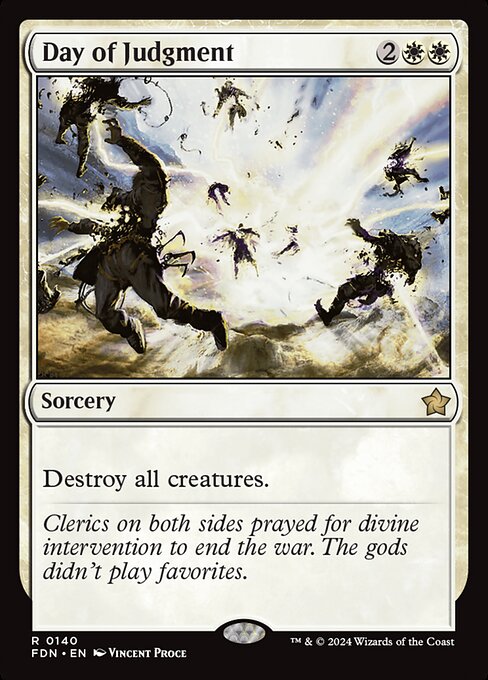
Day of Judgment: a board wipe
Destroys all creatures, including your own, without targeting them individually. Indestructible protects against this destroy effect; hexproof by itself does not.
SpellArmory Tip
When asking a rules question, specify which card is being used. “I’m wiping the board” doesn’t tell us whether creatures are being destroyed, exiled, or something else. The actual card text determines what happens.
Back to the alphabetical index
Deck building: strategy and synergy
Aggro
A strategy that applies early pressure and aims to win quickly, often with cheap attackers and direct damage. More about aggro, midrange, control, and combo can be found in the guide on deck archetypes.
Archetype
A recognizable deck strategy with various possible executions. This can be a broad playstyle, like control, or a more concrete plan, like tokens or sacrifice.
Bomb
An exceptionally strong card that can tilt a game heavily in your favor if no one has an answer. You mostly hear this term in Limited. Whether you should draft it also depends on your colors, mana, and deck plan.
Brewing
Developing and testing a deck idea yourself. A brew is such a custom list or experiment. It doesn't have to be completely original. For example, start with building a Commander deck from scratch.
Cantrip
A spell that, in addition to another effect, allows you to draw a card, often replacing itself. Usually cheap, though that is not a fixed rule. Simply replacing itself usually doesn't yield net card advantage; the rest of the effect might.
Card advantage
Having more usable cards or favorable card exchanges. Spending one card to draw two is a simple example. Removing two of your opponent's cards with one removal spell can also provide card advantage.
Combo
Cards or effects that together produce a particularly powerful outcome. A combo deck is built specifically around such a combination. Not every combo is infinite or wins the game immediately.
Control
A strategy that answers threats, builds resources, and tries to steer the game into a favorable late phase. Removal and counterspells can help with this, but not every deck with such cards is a control deck.
Curve / mana curve
The distribution of mana values in your deck. It shows how many cheap and expensive spells you are playing. What makes a good curve depends on your strategy, format, and available mana ramp.
Cutting
In deck building: removing a card from your list to make space. At the table, “cutting” can also mean splitting a shuffled deck. Context determines which meaning is intended.
The 99
In a Commander deck with one commander: the 99 other cards, including lands. If a pair of commanders is allowed, there are 98. “Good in the 99” means a card is useful without being your commander itself.
Enabler
A card that makes a strategy possible or allows it to function reliably. For example, a sacrifice outlet lets you sacrifice your own creatures so that other cards can reward you for it.
Filler
A less important card that fills a spot, for example because you are missing better options in Limited. What constitutes filler depends on the deck: a modest card might fulfill exactly the role you need.
Fixing
Ensuring you have the right colors of mana available. A land that can produce multiple colors helps with fixing but doesn't automatically provide more mana. A card can be both fixing and ramp.
Mana dork
A creature that produces mana, usually a cheap one like Paradise Druid. Such creatures help you get more mana faster. A tap ability of a creature is affected by summoning sickness.
Mana rock
An artifact that can produce mana, such as Mind Stone or Fellwar Stone. Rocks are mana sources that you use alongside your lands. Which colors they provide and what costs they require vary by card.
Midrange
A flexible strategy with efficient threats and answers. It can play defensively against a faster deck or apply pressure against a slower one. The name does not simply mean “all cards cost three or four mana”.
Netdecking
Taking an existing deck list from the internet or using it as a starting point. This can help you learn a strategy. Understanding why the cards are included remains useful, even if you didn't come up with the list yourself.
Payoff
The reward for your deck plan. If you make many tokens, a card that boosts them all can be a payoff. An enabler gets the plan going; a payoff utilizes the result.
Ramp
Increasing your mana faster than just your normal land per turn. Think of extra lands on the battlefield, mana dorks, and mana rocks. Players sometimes use the term more broadly; a one-time mana boost is often called a ritual.
Silver bullet
A targeted answer to a specific problem, for example, a card against graveyards. Especially useful when you expect that matchup or can search for the card. Outside of that situation, it might be less effective.
Singleton
A deck-building rule where you normally play a maximum of one copy of each card name. Exceptions depend on the format and card text. In Commander, basic lands are exempted, for example.
Staple
A widely used card that plays a useful role in many suitable decks. “Staple” does not mean it is mandatory or optimal in every deck. Sol Ring is a well-known Commander example.
Tech
A targeted card choice or adjustment for a specific opponent or metagame. For example, extra graveyard interaction because you often play against reanimator decks.
Value
Return on your cards, mana, and effects. For example, a creature that also allows you to draw a card or remove something. The term is broader and less precise than card advantage; context tells you what the player means.
Wincon
Short for win condition: the way your deck tries to win. This can be a single card, a combo, or a plan such as attacking with a large army. There is no set required number of wincons.
Card example: mana dork, mana rock, and fixing
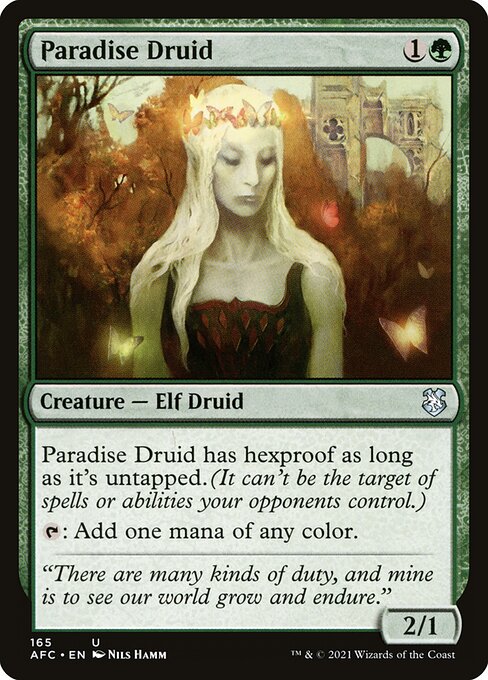
Paradise Druid: ramp and fixing
This creature can tap for one mana of any color. You get an extra mana source and help with your colors. The tap ability normally cannot be used until summoning sickness has passed.

Mind Stone: ramp without color fixing
This artifact can tap for one colorless mana. That helps you use more mana faster, but doesn't provide a missing color. Ramp and fixing are therefore not automatically the same thing.
Card images via Scryfall. Cards and illustrations © Wizards of the Coast and the respective illustrators.
Back to the alphabetical index
Cards and collecting
Alt art
An alternative illustration of the same card. Borderless, showcase, and extended art describe versions but do not automatically mean new art. See card treatments explained.
Bulk
Cards that are traded primarily in large batches, usually with a low individual market value. This can also include rares. A low price doesn't automatically mean a card is unusable in a deck.
Chase card
A card or version that many buyers are specifically looking for. This can be due to playability, art, scarcity, or popularity. It doesn't have to be a mythic and is not guaranteed to be present in a booster box.
Curling / pringling
The warping of cards, a phenomenon often discussed with foils. Sleeves do not automatically flatten a warped card. More about careful storage can be found in protecting and storing cards.
Grading
Having a specialized company evaluate aspects such as authenticity and condition, resulting in a grade and usually a sealed holder: a slab. Scales vary; PSA, for example, uses 1–10. Whether grading is worthwhile depends on costs, condition, and your collecting goal.
Playset
Usually four copies of the same card, according to the usual limit in many Constructed formats. You can also buy such a set as a Commander player, but that doesn't mean you can suddenly play four copies in one singleton deck.
Proxy
At casual tables, often a substitute card or playtest card: agree in advance whether these are welcome. In sanctioned tournaments, “proxy” has a specific meaning; only the Head Judge can issue one under tournament conditions. A counterfeit mimics a real card and can be mistaken for authentic.
Rare drafting
During a draft, choosing a card because of its rarity or trade value rather than its utility for your draft deck. You are balancing a collecting goal against the strength of your deck; it is not a metric for good or bad behavior.
Reprint
A card that is released again, possibly with different art or in a different version. This can increase supply. The price effect is not guaranteed: demand, print run, and the specific edition all play a role.
Reserved List
Wizards’ list of cards for which the published reprint policy excludes functionally identical, tournament-legal physical reprints. Digital and certain non-tournament-legal versions fall outside that policy. The list does not guarantee a minimum price or future value.
Sealed
As a product description: unopened and still factory-sealed. As a game mode: Limited where you build a deck from your own opened pool, normally six suitable boosters plus basic lands. The deck normally has at least 40 cards; special variants may differ.
Singles
Individual cards, as opposed to sealed products. My advice: buy a desired card directly if that specific card is your goal. Opening boosters offers no certainty that you will find it.
Spike: a price increase
A rapid, sharp price increase. Possible causes include increased demand, reduced supply, or speculation. The increase can also disappear again. Read more at how much is my MTG card worth?
The List
The name of a rotating selection of cards that appeared, among other things, as an extra in Set Boosters and certain Play Boosters, often featuring reprints. It is not a guaranteed part of every new booster. Check the set contents; a bonus card does not automatically become Standard-legal.
Back to the alphabetical index
Formats, Commander, and events
Bracket
In Commander: one of five optional categories to align expectations regarding decks and gameplay experience. It is not an exact power scale. Read Commander Brackets explained or start with the Commander basics.
cEDH
Competitive EDH: Commander with a competitive focus, efficient deck building, and attention to the metagame. It uses the same basic rules and Commander ban list. Fast wins are possible, but not every game ends after a few turns.
Constructed
Formats in which you build a deck in advance according to that format's rules. Examples are Standard, Modern, and Commander. The required deck size and allowed cards differ; Constructed therefore does not always mean a 60-card deck.
EDH
Elder Dragon Highlander, the original name of Commander. In casual conversation, players use EDH and Commander to refer to the same format.
FNM
Friday Night Magic: the weekly play program at participating WPN stores. The format offered varies by store. Check local options at MTG playing in Maastricht and Limburg and check the current schedule.
Game Changer
A card on Wizards’ official Commander list of influential cards. That list supports bracket agreements and is not a ban list. The number of Game Changers does not in itself say how strong or fast your entire deck is.
Limited
Game formats in which you build from a limited card pool for that play experience, rather than a pre-selected Constructed deck. Draft and Sealed are well-known examples; Cube uses a curated pool. See Draft explained.
Meta / metagame
The decks, strategies, and choices you expect to encounter. This can apply to large tournaments, a local store, or your own Commander group. “Good against the meta” means: suitable for that expected opposition.
Pod
A group of players who play or draft together. In Commander, this often refers to a table of four; a draft pod usually consists of eight players. The word itself does not mandate a fixed number.
Precon
Short for preconstructed deck: a deck built in advance. A Commander precon contains a complete Commander deck, but not every precon is for Commander. Help with choosing can be found in Commander precons for beginners.
Prerelease
An event centered around the introduction of a new set, before the general release. You often play Sealed with a Prerelease Pack. Exact dates and formats vary by set and store; check the event information.
Rotation
A change where older sets disappear from the legal card pool of a rotating format. Standard is a well-known example, but not the only one. Commander and Modern do not have set rotation; bans can change their legal card pool, however.
Rule 0
The conversation and agreements before a Commander game regarding play experience, decks, and any house rules. Exceptions require the consent of the table. Practical tips can be found in the unwritten rules of the play table.
WPN
Wizards Play Network: the official network for participating stores, with support and programs for organized Magic play. It is not a general requirement to play Magic at home or outside of such a store.
Back to the alphabetical index
Slang and table atmosphere
These words describe experiences and behavior. They are not official rules or objective labels for your fellow players.
Bolting
Hitting something with a Lightning Bolt, or used more loosely: with a similar direct damage spell. The nickname does not guarantee that the card used deals exactly three damage; the actual card text determines that.
Durdling
Performing many actions without clear progress toward a decisive position. Sometimes a joke about one's own deck, sometimes a criticism of slow play. The tone and context make a difference.
Feel-bad
A moment that feels unsatisfying or frustrating to someone, even if everything goes according to the rules. That feeling is personal: what one group loves to play, another group may find unpleasant.
Jank
An unusual, cumbersome, or intentionally less efficient card combination or deck strategy. The word can be used affectionately or critically. It is not an objective assessment and does not mean the deck can never win.
Kitchen table Magic
Casual play with friends, often with one's own collection and self-chosen agreements. The regular game rules remain the starting point; you agree on any deviations together. It is not a separate official format with one fixed deck list rule.
Kingmaking
A situation in which a player who has little hope of winning themselves mainly decides who else wins. How the group evaluates that depends on the circumstances. Not every attack on the leader is automatically kingmaking.
Pubstomping
Dominating a table that is playing at a lower level with a much stronger deck, especially when expectations are not intentionally aligned. One big victory or an unexpectedly good start does not in itself prove pubstomping.
Salt / salty
Frustration over a card, move, or game progression. A “salt score” reflects the opinions of a certain group of participants, not an official rule or universal judgment on which cards you are allowed to play.
Spike, Johnny/Jenny and Timmy/Tammy
Wizards’ names for different play motivations: challenge and mastery for Spike, creative self-expression for Johnny/Jenny, and the experience for Timmy/Tammy. They are not rankings of good or bad players; motivations can overlap.
Table talk
Discussing, negotiating, and persuading during a game, especially in multiplayer. For example, agreeing not to attack someone for one turn. Be clear about what you mean: such agreements are not card text that is automatically enforced by game rules.
Value town
A playful expression for a situation in which your deck repeatedly generates extra output: cards, tokens, mana, or other advantages. Having a lot of value does not automatically mean you have a way to win.
Back to the alphabetical index
Why do players use so much English?
Magic is released in multiple languages, but English card names and terms remain in common use in Dutch-language conversations. This aligns with English-language cards, deck lists, videos, and databases. Using “removal” or “ramp” makes it easy to find information even outside your own play table.
That does not mean you have to say everything in English. “Drawing a card,” “dealing damage,” or “target” are perfectly clear words. When in doubt, it helps to take the card text and ask what someone means exactly.
Tip from SpellArmory
Hearing an unknown term is no problem. Ask for an example: “Which card do you mean?” or “What exactly happens then?” Missing a word in this list? Feel free to send me a message.
From words to playing
Check out the decks, boosters, and accessories at SpellArmory and choose what fits your way of playing.
Further reading
- Learning to play Magic: The Gathering
- MTG keywords: from flying to ward
- Deck archetypes explained
- Commander (EDH) explained
Sources and notes
Rule terms have been verified against Wizards’ rules and tournament documents. Slang does not always have one official definition: this guide describes common usage and indicates where context makes a difference.
- Wizards — Comprehensive Rules: including mulligans, game zones, targets, resolving, sacrifice, and mill.
- Wizards — Level One: Glossary of Terms: strategic concepts such as tempo, card advantage, and chump block.
- Wizards — Common Keywords: basic concepts and card keywords.
- Wizards — Commander: the format, brackets, and Game Changers.
- WPN — Magic Tournament Rules: legal cards and the specific rules for proxies, especially sections 3.3–3.4.
- Wizards — Official Reprint Policy: Reserved List and the scope of the policy.
- Wizards — What Are Play Boosters?: historical explanation of The List and the transition of booster types.
- Wizards — The Three Magic Psychographics: Timmy/Tammy, Johnny/Jenny, and Spike.
- WPN — Friday Night Magic and Wizards — Prerelease: official event information.
- PSA — Grading Standards: an example of a professional grading scale.

Written by Omèr Cremers
Owner of SpellArmory, social worker, and full-time father. Fanatical MTG player and collector from Maastricht — Commander is my favorite format. Questions about which product fits you? Feel free to send me a message.