

Content checked: .
Your precon has a few games under its belt, and you're starting to notice what you enjoy. Perhaps you want to play your commander sooner, stop sitting with an empty hand so often, or finally be able to do something about that one enchantment. This is a great time to upgrade your Commander precon.
You don't need to replace half the deck immediately. Precons vary significantly in composition: some have a strong foundation, while others combine multiple plans that you can refine. A good upgrade solves a recognizable problem while preserving what makes your deck fun.
In this guide, you will work with ten possible swaps. You'll receive card examples, explanations of key differences, and advice on what to cut to make room. This is a method to apply to your own precon, not a fixed shopping list that fits every deck.
Start with the problem, not the most popular card
First, play a few games with the original list. Five games is a useful starting point to collect notes, but not yet proof that a card is good or bad. Most importantly, write down why something didn't work.
| What do you notice? | What to check first? | Possible improvement |
|---|---|---|
| You miss early land drops | The number of lands, your opening hands, mulligans, and the mana curve. | Finding more reliable mana. Don't automatically cut lands for mana rocks. |
| You have mana, but the wrong colors | Which colors your early spells require and how many sources you have for them. | Better color distribution or fixing: cards that provide the right colors. |
| Your hand runs empty | How often your draw cards actually work and whether your commander provides card advantage. | A fitting draw engine or a spell that provides new cards immediately. |
| A threat remains on the board | Whether your answers can hit the right types of cards. | A broader mix of creature, artifact, enchantment, and graveyard interaction. |
| You do a lot, but don't win | Whether your cards work toward the same end goal. | A clearer win plan, a better payoff, or fewer disjointed sub-plans. |
Your theme should influence your choices from the beginning. A creature that searches for a land can support both your ramp and your creature plan. A draw card that only works when you attack fits poorly into a deck that primarily wants to defend.
Which cards should you remove from your precon?
Place potential cuts next to the cards you want to add. Evaluate their function, cost, and synergy with the rest of the deck. This prevents you from removing the most expensive creature when it was actually the only way to close out a game.
- An expensive effect with too little payoff. What does the card do when you're behind? An expensive creature without an immediate effect might be a candidate, but creature type, reanimation, or other synergies could still make it valuable.
- A sub-plan that barely gets support. Choose which direction you want to strengthen. Remove cards that contribute little to it, after checking whether you're not missing their synergy with other cards.
- More cards for the same role than necessary. If you already have enough heavy finishers, an extra draw spell might yield more than another big attacker.
- An answer that is rarely useful in your group. Targeted artifact removal can be excellent. Look at the decks you play against before dismissing it as too situational.
Check that your deck remains legal
Your deck must have exactly one hundred cards, including your commander or commanders. Outside of basic lands and cards that allow an exception, you use a maximum of one copy per card name. Also, check color identity: it doesn't just depend on the mana cost. A card with a colored mana symbol in an ability can fall outside your colors.
For example, this means you don't add a second Arcane Signet if it's already in the precon. And a blue-white Talisman doesn't belong in a purely blue deck. The official Commander rules in chapter 903 establish the deck-building conditions and exceptions.
A practical plan for ten swaps
This distribution is my suggested starting point. If your deck already has enough ramp, use those slots for the problem you actually encounter. The numbers below are swaps within your existing deck, not the total counts your deck needs.
| Slots | Goal | What can go out? |
|---|---|---|
| 1–3 | Three cards for ramp or better mana. | Slow ramp without a useful extra function, or a redundant expensive spell. |
| 4–5 | Two cards that replenish your hand. | A weak draw card or a poorly supported sub-plan. |
| 6–8 | Three answers to relevant threats. | Clunky removal or cards from an overcrowded role. |
| 9 | One land with a clearly better function. | Another land, while maintaining sufficient colored mana. |
| 10 | Protection or a targeted theme card. | A card that contributes less to your chosen plan. |
1–3: choose ramp you can play on time
Ramp increases the amount of mana you have available. Fixing helps you produce the right colors. One card can do both, but those functions are not the same: a colorless mana rock does not solve a shortage of white mana.
For example, a two-mana rock can help you play a four-mana spell on turn three, provided you also hit your land drops and have the right colors. First, check which ramp is already in your precon.


| Card | Why consider it? | What to watch out for? |
|---|---|---|
| Arcane Signet | Two mana; provides a color from your commander's color identity. | Often already present. In a completely colorless deck, it produces no mana. |
| Fellwar Stone | Two mana; can provide colors that opponents' lands could produce. | Dependent on their lands. It doesn't automatically provide all your colors and doesn't produce colorless mana. |
| Mind Stone | Two mana; produces colorless mana. Later you can turn it into a card. | Drawing the card costs one mana, tapping it, and sacrificing the Mind Stone. |
| Talismans and Signets | Two-color rocks, also usable in decks with more colors. | e.g., Talisman of Progress: colorless without life loss, white or blue with one damage to you. Azorius Signet requires one mana and tapping to make white and blue. |
Green can also search for lands
Rampant Growth costs two mana and puts a basic land onto the battlefield tapped. Nature's Lore searches for a card with the land type Forest; this can also be a non-basic Forest. Nature's Lore does not force the land to enter tapped, but a condition on the land found might do so. Cultivate costs three mana and searches for up to two basics: one tapped onto the battlefield and the other to your hand.
Choose what fits your deck. Land ramp survives an effect that destroys artifacts, while mana rocks can provide extra value in an artifact deck. Also check if there are enough suitable targets in your list.
What can go out? For example, a ramp card of three or four mana whose extra ability you don't use. Maintain useful synergies and don't just lower your land count: the rock must be castable first.
4–5: combine direct draw with a fitting engine
A draw engine can provide significant value over multiple turns. A one-time draw spell helps when you need new options immediately. Both can earn a spot. When evaluating an engine, ask yourself how often you truly hit the condition, even without your commander.
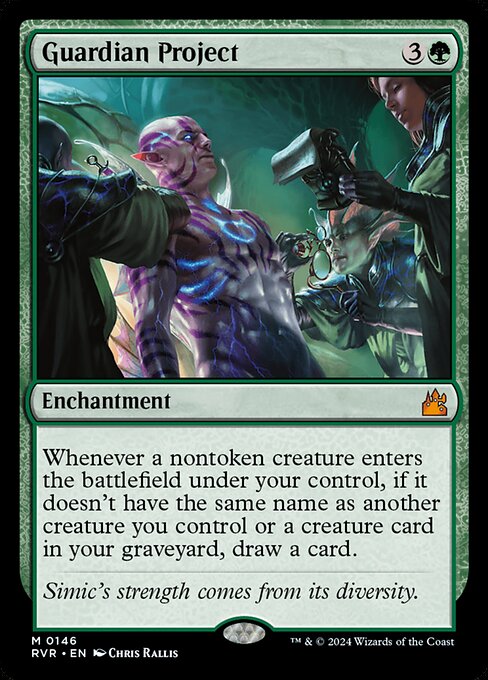
These two green cards work differently. Guardian Project checks for a nontoken creature entering under your control, with an additional name condition: no other creature you control or creature card in your graveyard may have the same name. This often works in singleton decks, but copies can cause issues. A recurring creature can trigger a draw again if the condition is met.
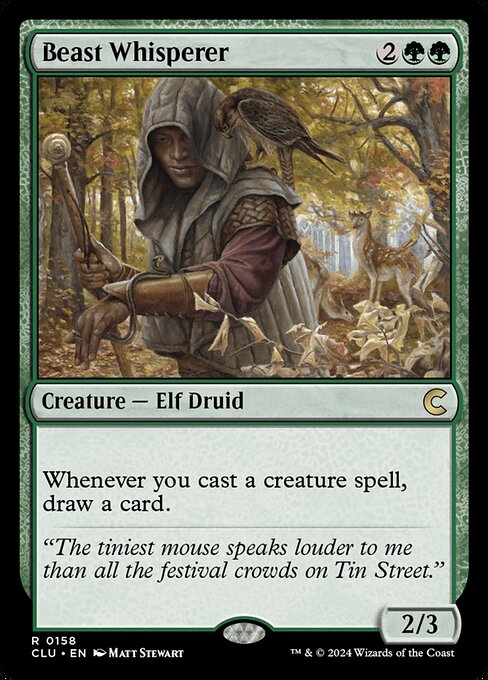
Beast Whisperer triggers as soon as you cast a creature spell. The creature does not need to resolve successfully for this. Putting a creature directly from your graveyard onto the battlefield or creating a token is not a cast and thus does not activate this ability. A token deck must also look further for Guardian Project: it explicitly requires nontoken creatures.
| Color and example | What does the card do? | Fits best when... |
|---|---|---|
| White: Mentor of the Meek | Whenever another creature with power 2 or less enters under your control, you may pay one mana to draw a card. | You create many small creatures or tokens and can hold up mana. Power-increasing effects can prevent the trigger. |
| Blue: Quick Study | Three mana, instant: draw two cards. | You want to hold up mana for interaction and spend it on cards otherwise. |
| Black: Night's Whisper | Two mana, sorcery: draw two cards and lose two life. | You are looking for a simple way to refill your hand immediately. |
| Red: Wrenn's Resolve | Two mana, sorcery: exile the top two cards; you may play them until the end of your next turn. | You have enough mana to utilize the temporary options. This is not draw; normal timing and your land-play limit still apply. |
What can go out? A draw engine whose condition you almost never meet, or a card that is only good when you are already ahead. Count what your commander does, but also ensure you have an alternative for a vulnerable commander.
6–8: include answers that solve different problems
You don't need to destroy everything immediately. You do, however, want to be able to step in when a card takes over the game. Review your current mix: do you only hit creatures, or also artifacts, enchantments, and graveyards?
| Color | Examples | Key difference |
|---|---|---|
| White | Swords to Plowshares; Generous Gift | Swords exiles a creature and gives the controller life equal to its power. Gift destroys a permanent and gives the controller a 3/3 Elephant; indestructible prevents that destruction. |
| Blue | Counterspell | Counters a spell on the stack, not an activated or triggered ability. The cost requires two blue mana; not every multicolored deck can easily hold that up. | Black | Feed the Swarm | Destroys an opponent's creature or enchantment at sorcery speed. You lose life equal to the mana value of that permanent. |
| Red | Chaos Warp; Blasphemous Act | Warp lets the owner shuffle the permanent into their library and reveal the top card; a permanent card enters the battlefield. Act deals 13 damage to each creature and can become cheaper as more creatures are on the board. |
| Green | Beast Within; Return to Nature | Beast Within destroys a permanent and gives the controller a 3/3 Beast. Return to Nature lets you choose between destroying an artifact, destroying an enchantment, or exiling a card from a graveyard. |
A board wipe like Blasphemous Act plays a different role than a single targeted answer: it can also hit your own creatures. Its discount lowers the generic mana cost, not the red mana. And thirteen damage is no guarantee that every creature will die, for example, if they have indestructible.
Choose three swaps that fill gaps in your list. If you already have plenty of creature removal, graveyard interaction might be more important than another destroy spell. A few instant-speed answers provide flexibility, but a good sorcery isn't automatically unsuitable. You can read more about reacting in the stack and priority explained.
What can go? An answer that is too expensive for its function, has a restriction that often gets in your way in your group, or fulfills a role that is already well-covered. Keep enough ways to deal with different types of threats.
9: upgrade one land without weakening your colors
A tapped land is not automatically a bad card. It can add important colors, land types, or a useful ability. However, it is frustrating if your early turns are constantly slowed down. Always check when you need which mana.


- Command Tower: can produce any color in your commander's color identity and normally enters untapped. Check if it's already in your list; in a completely colorless deck, it produces no mana.
- Exotic Orchard: produces a color that a land an opponent controls could produce. Its utility therefore depends on their lands. It does not guarantee your colors.
- Bojuka Bog: enters tapped, produces black mana, and can exile a target player's graveyard upon entering. A conscious choice for interaction, with a tempo cost; your commander must have black in its color identity.
- Rogue's Passage: produces colorless mana. The other ability costs four mana and tapping to make a creature unblockable that turn. Especially interesting when one attacker really makes the difference.
- Reliquary Tower: produces colorless mana and removes your maximum hand size. Only useful if keeping a large hand outweighs an extra colored mana source.
What can go? Start with a land-for-land swap. Don't just replace a colored source with a colorless utility land. If you structurally have too few lands, this upgrade slot can become an extra land at the expense of a spell.
10: protect your commander in a way that fits your plan
How dependent is your deck on your commander? If almost everything grinds to a halt as soon as it disappears, protection can yield a lot. A deck that works independently might benefit more from extra draw or a thematic card.
Commander tax: from the command zone, you pay two generic mana extra for each previous time you cast that commander from that zone during the game. It is not about the number of times the commander dies. Casting from your hand does not get that surcharge.


- Swiftfoot Boots: costs two mana and gives the equipped creature haste and hexproof. Equip costs one. Your own spells and abilities can still target the creature.
- Lightning Greaves: costs two mana; equip costs zero. Gives haste and shroud. Shroud protects against targeted effects, but also blocks your own targets. That can be tricky if you want to attach extra Equipment or Auras.
- Heroic Intervention: costs two mana and gives your permanents hexproof and indestructible until end of turn. Good against many destroy and damage effects, but not against everything.
What can go? A less fitting protection card or a redundant card from another role. Keep the mana you need to actually have protection ready in mind.
Does your bracket change due to upgrades?
Commander Brackets help to discuss expectations before the game. They are optional and evaluate more than just a few well-known cards. The strategy, speed, and the way you want to win also play a part.
According to the official bracket classification, for Game Changers, the following applies:
- Bracket 1 and 2: no Game Changers.
- Bracket 3: a maximum of three Game Changers.
- Bracket 4 and 5: no maximum for Game Changers.
One Game Changer therefore already excludes brackets 1 and 2 within that classification. Conversely, a deck without Game Changers is not automatically bracket 2: a fast and strongly tuned plan can provide a different play experience. An unmodified precon doesn't automatically have the same bracket as all other precons either; Wizards has explicitly decoupled that fixed link.
Check your complete modified list and the current Game Changers list. Tell those at the table what you have changed and how the deck tries to win. For example: “I’ve mostly improved the mana and added extra answers; the attack plan has remained the same.” More about this can be found in the unwritten rules of the gaming table.
What do you spend on a precon upgrade?
Start with your own budget ceiling, not with a promise that a certain amount will fix every deck. Prices differ per card, version, condition, and seller. Shipping costs can be relatively heavy with multiple small orders.
- Check what you already have. Look in the precon and in your collection before buying the same card.
- Choose the most important two or three problems. First, work on the swaps that directly help with those.
- Compare regular versions. A more expensive illustration or foil doesn't make the same card stronger.
- Calculate with the total price. Include shipping and cut an expensive candidate if an alternative fulfills the required role well enough.
Test your changes and keep what you remove
Keep your original deck list and set the removed cards aside. Try the new version for a few games with a similar playgroup. Always note the same things:
- Mana: which early land drop or color did you miss? Could you play your spells at a logical moment?
- Cards: did your draw engine work even when you were behind, or only when everything was already going well?
- Answers: did you have useful interaction and were you able to keep the mana open for it?
- Plan: did you get closer to your intended way of winning?
- Enjoyment: does it still feel like your deck and does it fit the table?
One bad night doesn't prove that your upgrade failed. Opening hands, mulligans, mana curve, and chance all play a part. Change a small number of cards at a time, so you can better judge what helps. Don't just look at won games: a deck that participates more often and offers clearer choices can already be a successful improvement.
Frequently asked questions about upgrading precons
Do I have to replace ten cards immediately?
No. Ten is a workable framework here, not a mandatory number. Start with the clearest improvements and test those first. Cards that work well and are fun to play don't have to go just because there is still room on a list.
Are more expensive lands always the best first purchase?
No. If your colors work well but your hand keeps running empty, extra card advantage might be more useful. Upgrade your lands when you see a concrete problem there and check what the swap does to your colored sources.
Can I replace lands with mana rocks?
Sometimes a deck can manage with fewer lands after other adjustments, but that doesn't follow automatically from adding ramp. A rock in your hand doesn't help if you miss the mana to cast it. Only adjust the number of lands after assessing the entire curve and your test games.
Is a well-known staple better than a thematic card?
Not by definition. A thematic card can fulfill multiple roles at once, such as drawing cards and supporting your creature plan. Assess how often the card works in your deck and what you are giving up for it.
Sources and card information
The game rules and card operations have been checked against the sources below. The plan with ten swaps and the selection criteria are editorial recommendations; there is no official upgrade distribution that applies to every deck.
- Wizards of the Coast — Magic rules and Comprehensive Rules: Commander deck building and commander tax (903), equip (702.6), shroud (702.18), hexproof (702.11), indestructible (702.12), and creatures with toughness 0 or less (704.5f).
- Wizards of the Coast — Commander, Brackets and Game Changers: current classification and card lists.
- Wizards of the Coast — bracket update of February 9, 2026: explanation of the use of brackets and why precons are not standardly linked to bracket 2.
- Gatherer is the official card database. The card links in this guide open Scryfall, where the current Oracle text and different printings can be viewed.
Card images: Wizards of the Coast, displayed via Scryfall. Click on an image to view the card in larger size. The printed version shown is an illustration, not a recommendation to buy that specific version.

Written by Omèr Cremers
Owner of SpellArmory, social worker, and full-time father. Fanatical MTG player and collector from Maastricht — Commander is my favorite format. Questions about which product suits you? Feel free to send me a message.