

Content verified: .
You open a booster, pull something shiny, and the puzzle begins. Is this showcase or borderless? Is that sheen traditional foil or a special finish? And does a number at the bottom mean you have a rare serialized copy?
I get questions about this regularly, and I understand why. The names sometimes sound similar, while they describe different attributes. In this guide, you will learn to recognize the most important MTG card treatments, with real card examples and a practical checklist for your own collection.
Frame, finish, and numbering: three separate questions
Don't start with "how rare is this?", but with "what exactly am I looking at?". You can describe a card in three ways:
The layout of the card: for example, standard, extended art, borderless, showcase, or retro.
The surface treatment: non-foil, traditional foil, or a special foil treatment.
Does this copy have a distinct serial number within a limited run?
A card can be, for example, both borderless and traditional foil. Another borderless version might only exist in non-foil. Not every combination is printed. The available versions vary per card and set.
Also important: a nicer version does not give the same card stronger abilities. Compare the card name and current rules text, not the amount of shine.
Recognizing standard, extended art, and borderless
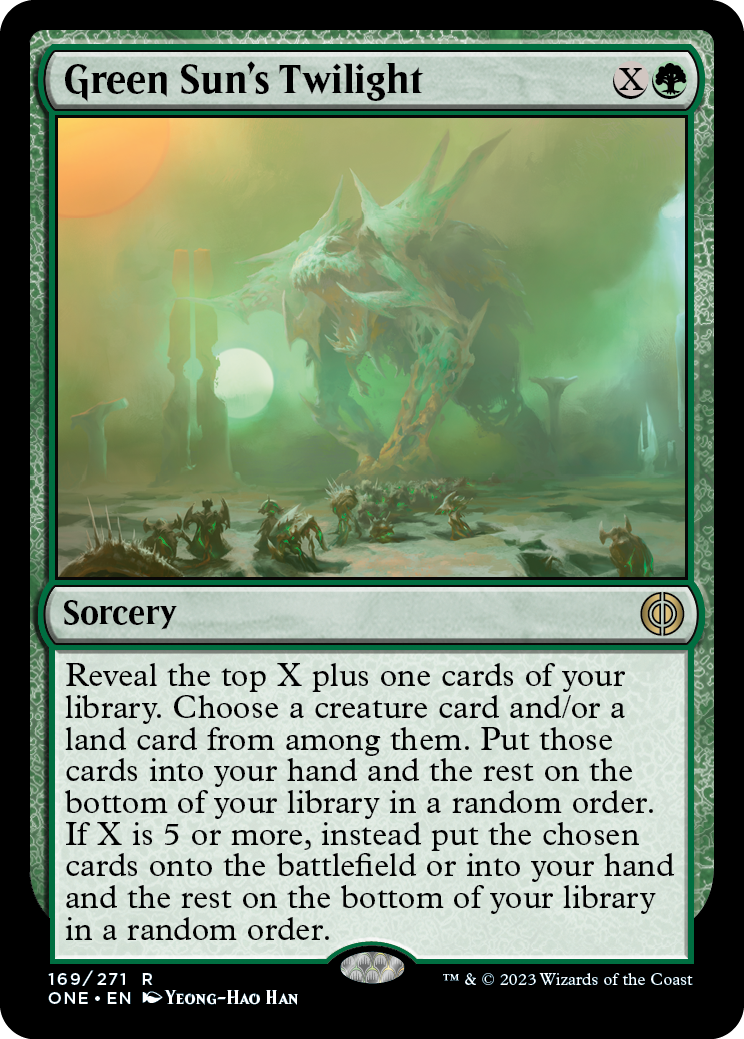
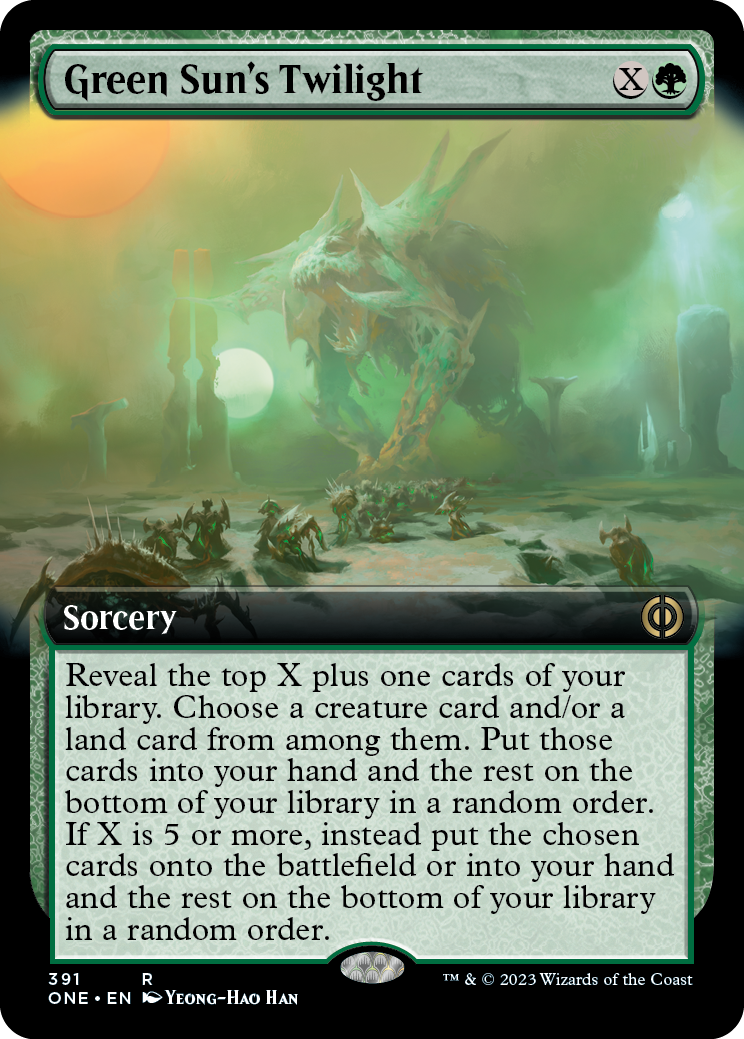
Standard versus extended art
In the standard frame, the illustration is contained within a clearly defined window. Extended art gives that illustration extra space on the sides; the layout around the name and text remains recognizable. Below, you see the same card in both versions.
Borderless, showcase, and retro
Borderless lets the illustration extend further and breaks the usual frame. Showcase is a collective term for special designs, often matching a world or theme. The specific name can differ per set. Retro frame uses the look of the old card design; a card in that frame does not necessarily have to be old itself.
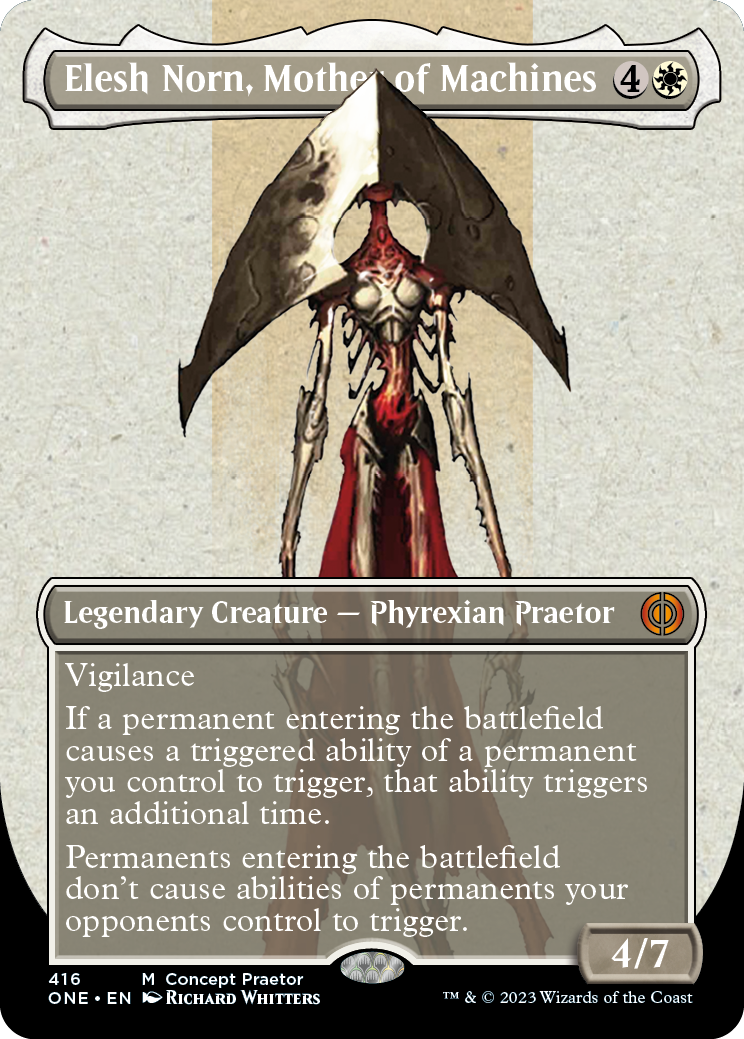
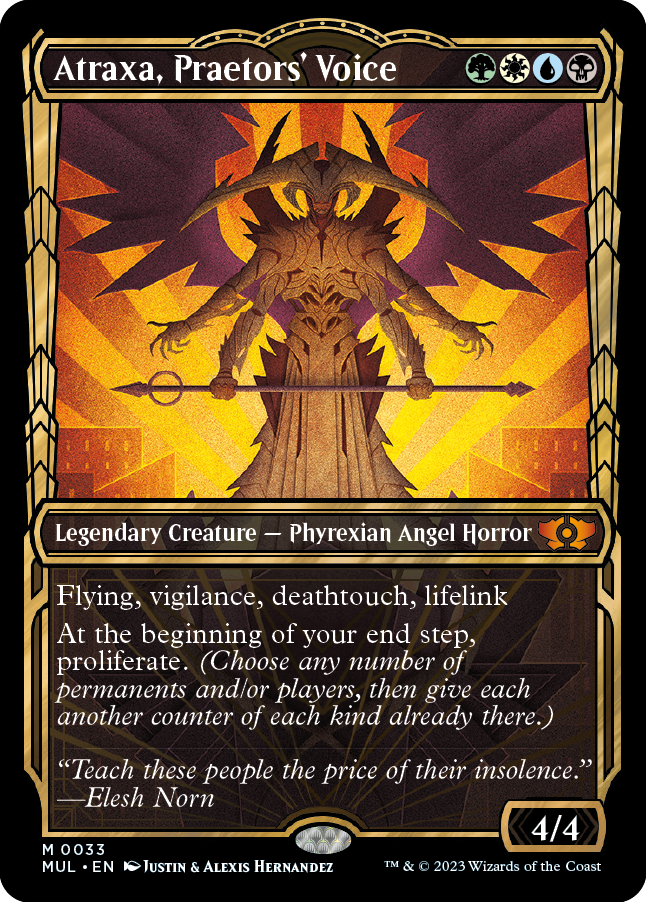
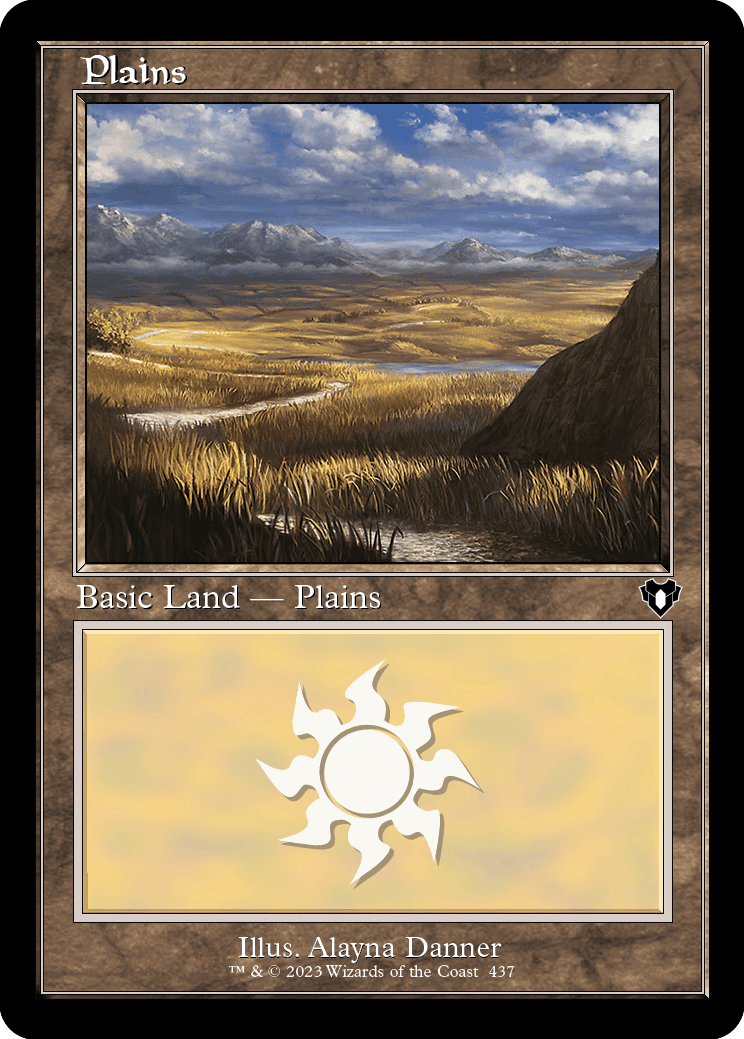
Official card images by Wizards of the Coast. Click a card to enlarge. These digital images show the design; they are not photos that can confirm a physical foil finish. Examples from Phyrexia: All Will Be One, March of the Machine, and Commander Masters.
Be careful with names in webshops. “Alternate art”, “full art”, and “showcase” are not always used precisely. Therefore, always check the image, set code, and collector number. A fancy title in an ad does not identify the card.
Which types of foil are there?
Traditional foil is the well-known rainbow-like shine. In addition, Wizards creates special finishes with patterns, accents, or textures. The list below helps you recognize the most important names; new sets may add new finishes.
A photo can show foil, but one image taken straight from the front is often insufficient. If in doubt, ask for multiple lighting angles or a short video of the actual copy. A digital card image is sometimes used for multiple finishes.
| Finish | What to look for? | Official example |
|---|---|---|
| Non-foil | No foil treatment. Can still have a special illustration or frame. | Many standard and alternate versions. |
| Traditional foil | The usual shiny foil, with colors that change when tilted. | Appears in many sets. |
| Foil-etched | A different shine and finish than traditional foil; in Commander Masters with a matte frame and special varnish. | Commander Masters |
| Textured foil | A foil treatment with extra texture. Verify the correct version; having the same art is not proof. | Commander Masters |
| Surge foil | A striking wavy pattern in the shine. | Doctor Who |
| Galaxy foil | A shimmering effect with dots that resemble stars. | Edge of Eternities |
| Halo foil | A special pattern in the shine, easy to see while the card is moving. | Multiverse Legends |
| Step-and-compleat foil | A repeating pattern of Phyrexian symbols in the foil treatment. | Phyrexia: All Will Be One |
| Gilded foil | Gold accents that emphasize the ornate frame. | Streets of New Capenna |
| Silverscreen foil | A silvery foil treatment on the black-and-white card style. | Innistrad: Double Feature |
| Neon ink foil | Striking colored ink accents in a special version. The color variant can also make a difference. | The colored Traveling Chocobo cards |
| Double rainbow / singularity foil | Two different special finishes. The name of the finish itself does not tell you if a card is numbered. | Edgar Markov and Sothera, respectively, below. |
The name of a treatment is not a general product guarantee. "Surge foil," for instance, does not mean every Universes Beyond set has such a version. Look at the product information for the specific release.
Serialized cards: what does 247/500 mean?
A serialized card has an individually printed serial number. In a run of 500, 247/500 means this copy is number 247 within that numbered series. This does not say how many regular, other foil, or foreign-language versions of the same card exist.
Collector number is not a serial number. A small number at the bottom of a card, sometimes written as, for example, 123/280, identifies the card within the set. All copies of that printing share that collector number. Therefore, it does not make your copy number 123 of only 280 printed cards.
The difference between Sol Ring and The One Ring
For The Lord of the Rings: Tales of Middle-earth, three numbered Sol Ring versions were released: 300 Elven, 700 Dwarven, and 900 Human copies. Additionally, unnumbered non-foil versions were released. The unique The One Ring with number 1/1 is a different card and a different release. You should not confuse it with the three Sol Ring series. Wizards explains the different Ring versions here.
Is every Headliner serialized?
No. Headliner is the name for a specially featured collector card. It is not a fixed foil type, nor is there a universal agreement that there are exactly 500 copies.
- Edgar Markov: the movie poster Headliner from Innistrad Remastered received 500 numbered double rainbow foil copies. Official explanation.
- Golden Chocobo: the gold Traveling Chocobo from Final Fantasy received a run of 77, exclusively in English-language Collector Boosters. Official explanation.
- Sothera, the Supervoid: the Headliner of Edge of Eternities is the textless singularity foil version, without individual serial numbering. Official explanation and image.
A rare card does not have to be serialized. And a numbered card does not have to fit a general rule for future sets.
"Less than 1%" is not a promise per box
If Wizards mentions a chance of less than 1%, you do not know the exact percentage. You cannot turn that into a reliable statement like "one per eight boxes".
A calculation example: with a hypothetical chance of exactly 1% per independent pack, the chance of at least one hit after 100 packs is about 63.4%. The chance of zero hits is still 36.6%. This is an illustration of probability, not a published pull rate for a specific card.
Which version do you have? Check these five things
- Card name: look up the exact card. When using a translation, also use the English name as a reference.
- Set code and collector number: read the small data at the bottom and compare it with the official card gallery or a card database like Scryfall.
- Illustration and frame: does the image match? Do not search by card name alone.
- Finish and any numbering: tilt the card in the light and check which versions of this print actually exist.
- Language and condition: include those when comparing prices. Damage does not disappear just because a card is special.
For online purchases, a sharp photo of both the front and back helps. For a valuable foil, also ask for an angled shot. A stock photo may illustrate the version but does not prove the condition or authenticity of the copy offered.
Quick recognition check: is a borderless card always foil?
No. Borderless describes the layout. You check whether the card is non-foil, traditional foil, or a special foil separately.
A card has 123/280 at the bottom. Is it serialized?
Not based on that. That could be the collector number. Look for a distinct serial number and check whether a serialized version of that card even exists.
In which boosters can you find special treatments?
The official "Collecting" page for the set is the best starting point. Check the treatment, product name, and any language restrictions there. The categorization below provides direction; it is not a universal content list.
| Product | What to expect? | What to look for? |
|---|---|---|
| Play Boosters | Cards for playing and Limited, with foil and alternate frames depending on the set. | Borderless or showcase are not automatically exclusive to Collector Boosters. |
| Collector Boosters | A selection emphasizing foils and special versions. | Regular frames also appear. No guarantee on the specific card or finish you are looking for. |
| Special decks, promos, and other products | Sometimes have their own versions or finishes. | A Collector’s Edition deck is not the same as a Collector Booster. Read the exact product contents. |
You can read more about the differences in MTG booster types explained. Looking for one specific version? Then compare the listings of individual cards; that provides clarity in advance about which card you are buying.
Does a special treatment make a card worth more?
Not automatically. There is no reliable ladder where foil is always above non-foil and borderless is always above standard. Availability, collector demand, playability, condition, and preference for an illustration all play a role.
Therefore, compare the exact version. Moreover, an asking price is not yet a realized selling price. For a sparsely traded serialized card, a convincing comparison can be difficult. A "nice" serial number does not automatically provide a fixed premium either. You can read more about this in How much is my MTG card worth?
Tip from SpellArmory: first determine what you like and what you want to spend on it. A favorite commander in a special version can provide a lot of enjoyment without having to replace the entire deck. For a game card, the functionality does not change because of a more expensive finish.
Storing and playing with foils
A foil can warp. Sleeves help protect against wear, but they are no guarantee that a card will remain flat. Treat foil-etched cards with care as well; the name of the finish is no guarantee against warping.
- Use appropriate sleeves and store cards in a clean, dry environment with minimal fluctuations in temperature and humidity.
- Protect individual collector cards during transport with a suitable holder. Do not force a card into a tight opening.
- Avoid using heat, water, or aggressive bending as a quick fix for warped cards.
- Check both cards and sleeves before a tournament. Damage or warping can make a card identifiable.
Are foil and borderless cards allowed in tournaments?
A special treatment does not automatically make a card illegal. However, the card must be legal in the format being played and meet all requirements for legal cards. Furthermore, you must not be able to identify it from the back or by its shape within your deck.
Opaque sleeves do not always solve this: a severely warped card can remain identifiable even inside a sleeve. When in doubt, have your deck checked by a judge before the start. The relevant rules are set out in sections 3.3, 3.11, and 3.12 of the Magic Tournament Rules.
Which treatment suits your collection?
For a gaming budget, choose the most affordable version you like. For a favorite deck, you can selectively replace one commander or a few cards. For a thematic collection, consistent frames or art styles are a logical starting point.
You don't need to collect every new foil type. If you look at frame, finish, and numbering separately, you can choose much more deliberately — and you'll have a better understanding of what you're buying.
Looking for more at SpellArmory
Check out the MTG sets and read the product description for each item to see which treatment it is. Unsure about a treatment? Feel free to send me a message, preferably with a photo of the card and the information at the bottom.
Sources and card images
Product-specific examples have been verified against the official Wizards pages linked in the text and table. For serialized Sol Rings, we used the official explanation provided for The Lord of the Rings; for Headliners, those from Innistrad Remastered, Final Fantasy, and Edge of Eternities. For tournament usage, the edition of the Magic Tournament Rules available via WPN as of February 27, 2026, was consulted.
Card images: Wizards of the Coast, sourced from official collector materials. Illustrations and card designs remain the property of their respective owners. The images are used here to explain card treatments. No AI-generated card images or simulated foil effects have been used.
The advice on choosing, comparing, and storing is editorial commentary by SpellArmory. This guide contains no guaranteed value increases, current price claims, or stock promises.