

Last updated: September 28, 2026
SpellArmory Academy · Returning Players
In short
- Your old cards haven't expired. The format, ban list, and your deck construction determine what you can play with them.
- The basics have remained recognizable. Specifically, the mulligan and some combat rules deserve a refresher.
- Commander and product offerings have become much more prominent. Play Boosters have merged the roles of Draft and Set Boosters in the regular set line.
- You don't need to catch up on years of releases. First, choose who and how you want to play. Only then decide what you need.
You find an old deck box, flip through your binder, and get excited about Magic again. Then you see new card frames, Commander decks, and characters from other worlds. Where do you start?
This guide helps you pick up the thread. First, we look at your old cards and a suitable format. Then follow the most important rule changes, modern boosters, and other changes you will encounter at the table.
How long have you been away?
Stopped before 2010
Be sure to check out mana burn, combat damage, and the mulligan. Were planeswalkers not around yet when you played? Also, read the explanation about card types and new terms.
Stopped between 2010 and 2018
The London Mulligan and the 2024 combat change are important. Furthermore, Commander, digital Magic, and the product line have changed significantly.
Stopped between 2019 and 2023
Look at Play Boosters, the new combat rules, and the legality of Universes Beyond. You likely already know many other basic rules.
Stopped only recently
Check the current card pool and ban list for your format primarily. For Commander, a conversation about deck strength is more helpful than trying to memorize every missed release.
1. Can you still use your old Magic cards?
Yes, usually. A card does not become unusable because the printing is old. Magic has different formats: agreements regarding deck construction, allowed cards, and game rules.
| Format | What does this mean for your collection? |
|---|---|
| Casual with friends | You agree together on which cards and decks are appropriate. For example, you can start by playing with your old decks. |
| Commander | A broad card pool from Magic's history. Check the ban list, color identity, and the other Commander deck-building rules. |
| Modern | The card pool starts at Eighth Edition and Mirrodin from 2003, with additional permitted releases. Not every card printed since 2003 is automatically Modern-legal. |
| Pioneer | A non-rotating format with allowed sets starting from Return to Ravnica in 2012. Check the card itself; standalone Commander releases do not automatically add cards. |
| Standard | Uses a rotating selection of recent sets. An old printing can participate if the same card is allowed in the current card pool. |
| Draft or Sealed | You build for the event using the cards you receive there or draft. You don't need to bring a current constructed deck. |
The card and the print are not the same
If an old card is reprinted in a Standard-legal set, you can generally use your old copy as well. You don't need to buy the same card again just because it has a new set symbol on it.
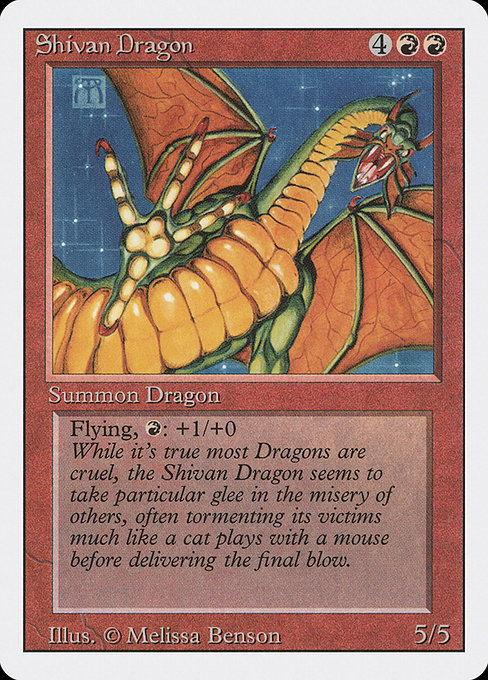

Example: Shivan Dragon is included in Foundations and is Standard-legal as of this guide's review date. Therefore, you can also use a regular Revised printing from 1994. Both versions work according to the same current Oracle text. A different frame or illustration does not change the game rules.
For official events, your copy must also meet tournament conditions. Special collector editions with a different back, for example, are not automatically allowed. Furthermore, legal does not mean that a card is the strongest choice for your deck.
Standard: this is the situation in September 2026
Standard has shifted from roughly two to roughly three years of sets. There is no rotation in 2026. From 2027, rotation is linked to the first major set release of the calendar year. According to Wizards, Foundations remains Standard-legal until at least 2029.
When building, use the official Standard page and the official ban list. Even a non-rotating format like Modern can change due to new cards and bans.
2. Why do you see so much Commander?
Commander, also known as EDH, is a widely played way to play Magic together. It is usually multiplayer and gives old cards plenty of room. The basics:
- 100 cards including your commander. Normally you choose one legendary creature as your commander; some cards and abilities make exceptions possible.
- Normally one copy per card name. Basic lands and cards that explicitly allow otherwise are exceptions.
- Color identity determines your colors. This goes beyond just the mana cost in the top right.
- 40 starting life. Additionally, you lose if you have taken 21 or more combat damage from the same commander.
- Commander tax. Every previous time you cast that commander from the command zone adds two generic mana to a subsequent cast from that zone.
For the full explanation, read Commander (EDH) explained. For your first night, the most important thing is that the decks match: “casual” does not mean the same thing to everyone.
Commander Brackets and format management
In September 2024, Wizards took over management from the independent Rules Committee and works with input from the Commander Format Panel. Since 2025, there has also been a system with five Commander Brackets, intended to discuss expectations regarding the play experience.
The system is still being developed in beta. Use the current Commander explanation from Wizards. A bracket does not replace a conversation about fast combos, deck strength, and what the group enjoys.
SpellArmory Tip
My advice: for your first night, join with a deck whose game plan you understand. A Commander precon can be handy for that, but a borrowed deck is also a great start. Mention that you are returning and ask if the other decks are a good match. Check out the Commander precons for beginners if necessary.
3. The game rules you want to refresh
You don't need to learn every rule change in Magic's history. These points will prevent many misunderstandings when old habits resurface.
The London Mulligan: always choosing from seven cards
Since 2019, the regular mulligan works as follows: shuffle your hand back into your library, draw seven cards again, and place cards from that new hand on the bottom. The number depends on how many mulligans you have taken.
In multiplayer, such as a normal Commander game with four players, the first mulligan does not count toward that reduction. Brawl also has a free first mulligan.
| Mulligans taken | Standard / Modern 1-on-1 | Multiplayer Commander |
|---|---|---|
| None | 7 cards | 7 cards |
| One | 6 cards | 7 cards |
| Two | 5 cards | 6 cards |
There is no extra scry with this mulligan. You select the cards that go to the bottom yourself; they are not random cards.
Since 2024: no fixed damage order for blockers
If your attacker is blocked by multiple creatures, you no longer set those blockers in a mandatory damage order in advance. During the combat damage step, you distribute the damage among the blockers. You do not have to assign lethal damage to one blocker before another blocker can receive damage.
Example: a 5/5 against two 3/3 blockers
You may assign 2 damage to one blocker and 3 to the other. Without other effects, the blocker receiving 3 damage dies; your 5/5 takes 6 damage in total and also dies.
There is no moment to react between assigning and dealing that damage. If you want to use a combat trick, do it before the damage step. Trample keeps its own condition: only after all blockers have been assigned lethal damage can excess damage carry over.
Since 2009: combat damage does not use the stack
You can no longer “lock in” combat damage on the stack and then sacrifice your creature to still have it deal that damage. If you sacrifice it before combat damage, it deals no combat damage in that step. Spells and many abilities still use the stack.
Since 2009: no mana burn
Unused mana normally disappears at the end of every step and phase. You no longer lose life for this. An effect can explicitly make an exception to the disappearance of mana.
Since 2013 and 2017: the current legend rule
If you control multiple legendary permanents with the same name, you choose one to keep and the others go to the graveyard. An opponent may control a copy with that name at the same time.
Planeswalkers have also followed this rule since 2017. Two different Garruk cards may therefore lie side by side under your control; two copies of Garruk Wildspeaker normally cannot. It concerns the card name, not the planeswalker type.
For a smooth restart, you can find more explanation in the basic guide to Magic and the guide to the stack and priority.
4. Recognizing new words and card types
Part of what seems new is mostly just a different name for something you already know. The official, current card text is called Oracle text. That also applies even if your old card says something else.
- In play → battlefield. The zone where your permanents lie.
- Removed from the game → exile. A separate game zone; cards can return from it via specific effects.
- Converted mana cost → mana value. The modern name for this value.
- Summon … → Creature — … Old creature cards now use this type designation in their Oracle text.
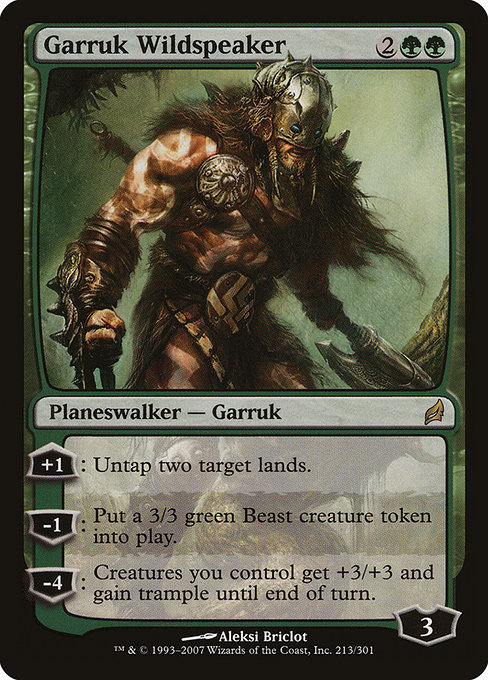
Planeswalkers: loyalty instead of power and toughness
Planeswalkers have existed as a card type since 2007. They enter with the indicated number of loyalty counters. Normally, you may activate a maximum of one loyalty ability per turn per planeswalker, during your own main phase, with an empty stack and when you have priority.
Garruk Wildspeaker starts with 3 loyalty. His +1 adds one counter as a cost; his −1 removes one. For his −4, you need at least four loyalty.
You can attack an opponent's planeswalker. Damage removes loyalty; at 0 loyalty, it goes to the graveyard. This old print doesn't yet call him “legendary,” but the current rules and Oracle text do.
Additionally, you will encounter things like Equipment, double-faced cards, Sagas, Vehicles, and battles. Not every card is a standard creature or sorcery. Read the card type and instructions on the card; you don't need to know all mechanics in advance.
Unknown terms? Use the keyword guide for abilities like ward and menace, or the MTG glossary for other concepts.
5. Which booster is the regular one nowadays?
Since Murders at Karlov Manor in 2024, the Play Booster in the regular set line combines the functions of Draft and Set Boosters. The exact contents and the number of packs per box can vary per release.

Play Booster
Designed for Limited, such as Draft and Sealed, and for opening cards. This is usually the pack you are looking for when you want to draft a recent set.

Collector Booster
Focused on special versions, such as foils and alternate art. The contents are set-dependent. This is a collector's product and not the usual pack for Draft.
Pictured: the Bloomburrow Play and Collector Booster, as a recognizable example of the two product types.
You may still encounter older Draft and Set Boosters. In addition, there are special products such as Jumpstart: usually, you combine two themed packs, including lands, into a playable deck. So check the specific product instead of just the word “booster”.
Read more about the different booster types or how Draft works.
SpellArmory Tip
Looking to restore one specific deck? First, make a list of missing cards. My advice is to keep targeted purchases for that separate from opening boosters for fun. A random pack does not guarantee the card you need.
6. Other worlds, more releases, and special versions
Universes Beyond: official Magic in other worlds
Characters from, for example, The Lord of the Rings, Final Fantasy, and Marvel appear on official Magic cards. These products are called Universes Beyond. They use the Magic rules, but their format legality depends on the card and the release.
- From 2025 onwards: the main sets of new Universes Beyond booster releases will follow the regular path to formats including Standard, Pioneer, and Modern.
- Extra cards may vary: Commander decks, bonus cards, and Special Guests do not automatically belong to that same card pool.
- Older releases do not change retroactively: For example, 2023's The Lord of the Rings: Tales of Middle-earth did not become Standard or Pioneer legal because of this.
Finding a card in a booster is therefore not sufficient proof that it is allowed in Standard. Check the card itself.
You don't have to follow every release
The old block structure is gone and worlds rotate faster. Seven major sets are scheduled for 2026. For 2027, Wizards has announced six major sets: three Magic Multiverse sets and three Universes Beyond sets. This is the announced schedule for 2027, not a guarantee for every year thereafter.
My advice: follow your own format or deck first. A new set does not suddenly make your existing Commander deck invalid, and you don't have to know every new mechanic to play with friends.
Different look, same card
Borderless, showcase, and extended art describe finishes. Additionally, there are different foil treatments and sometimes numbered, serialized cards. Such a version does not in itself change the way the card works.
Always compare the card name and Oracle text. A more luxurious version is not an extra copy for your deck limit: four different illustrations of the same card still count as four copies of that card.
7. Practicing digitally and viewing your collection
MTG Arena as a refresher
MTG Arena is available on desktop and mobile and handles many game actions automatically. The introduction and practice games can help you get the hang of turns, attacking, and responding again.
Your paper cards and your Arena collection are separate. Arena also has its own range of formats and cards. Choose carefully what you want to practice; a digital playing experience is not automatically the same as your Commander night with friends.
Is your old collection still worth anything?
Old does not automatically mean expensive. First, identify the exact printing, language, foil treatment, and condition. For older cards, things like the illustration, border, set symbol, and copyright line help; modern cards often also have a set code and collector number.
Look up the correct version and then compare prices of similar copies. A high asking price is not automatically the amount you can sell your card for. Practical steps can be found in How much is my MTG card worth?
SpellArmory Tip
Don't just sort by sales value. Also set aside what you would like to play again. A cheap card might fit perfectly into your old deck, a Commander plan, or your own Cube.
A practical plan for your first game night
- Ask what the group plays. Commander, casual 60 cards, a specific constructed format, or Limited?
- Choose or borrow one deck. Check the deck construction and legality before you buy missing cards.
- Brush up on the relevant rules. Start with the mulligan, combat, and the abilities on your own cards.
- Say that you are returning. Agree that unknown cards will be explained and that you may consult others regarding timing.
- Evaluate after a few games. Only then will you know better whether you need singles, a different deck, or nothing at all.
Should I buy a new deck right away?
No. For casual games, old or borrowed decks may be enough. For an official format, your deck must meet the current rules. A precon is a handy option if you are looking for a complete deck, not a prerequisite for returning.
Is Commander always the easiest way to return?
Not for everyone. It is social and you can use many old cards, but four players and many different abilities can be busy. Quiet games with two simple decks might be a better fit if you want to brush up on the basics first.
Do I have to use cards from other franchises?
You can build your own deck around Magic's own worlds. In an official format, opponents may use all cards that are legal there. With friends, you can make other arrangements in advance.
Want to get back to the table?
Check out the Commander decks at SpellArmory if you are looking for a complete deck. Still doubting your return? Feel free to send a message about what you used to play and how you want to play now.
Sources and currency
Checked on September 28, 2026. Format legality, ban lists, and release schedules are subject to change. Game rules are based on the current Wizards of the Coast rules. Personal recommendations are stated as advice or "SpellArmory Tip".
- Wizards: the London Mulligan.
- Wizards: the combat change in Foundations.
- Wizards: introduction of Play Boosters.
- Wizards: Universes Beyond and Standard rotation.
- Wizards: the announced planning for 2027.
Card images via Scryfall; card images and Magic: The Gathering are from Wizards of the Coast. Tap a card for a larger view. Product images: SpellArmory.

Written by Omèr Cremers
Owner of SpellArmory, social worker, and full-time father. Fanatical MTG player and collector from Maastricht — Commander is my favorite format. Questions about which product suits you? Feel free to send me a message.